

Updated 13 hours ago
Smart Ring Manufacturer: How to Choose a Reliable OEM & ODM Partner
youhong
Introduction: Why Choosing the Right Smart Ring Manufacturer Matters
The global smart ring market is entering a rapid growth phase, driven by rising demand for continuous health monitoring, sleep tracking, sports recovery, and medical-grade wearables. As more brands, healthcare companies, and technology platforms enter this space, one critical decision determines success or failure:
Choosing the right smart ring manufacturer.
Unlike consumer electronics such as earbuds or power banks, smart rings combine biomedical sensors, ultra-low-power electronics, precision manufacturing, algorithms, and regulatory compliance—all within an extremely small form factor. This makes OEM and ODM partner selection far more complex and high-risk.
This guide is written for:
- Brands launching a custom smart ring
- Companies seeking a private label smart ring
- Healthcare or wellness platforms integrating wearable data
- Distributors evaluating a smart ring factory in China
From a manufacturer’s perspective, we explain:
- OEM vs ODM for smart rings
- Core capabilities to evaluate
- R&D, compliance, and production realities
- Cost, MOQ, and customization factors
- A practical partner selection checklist

What Is a Smart Ring Manufacturer?
A smart ring manufacturer designs, develops, and mass-produces wearable rings equipped with sensors, firmware, algorithms, and connectivity for health and activity monitoring.
Unlike assembly-only suppliers, a professional smart ring manufacturer typically provides:
- In-house R&D (hardware + firmware + algorithms)
- Sensor integration (PPG, SpO₂, temperature, ECG, motion)
- Low-power system design
- Mobile app, SDK, or API support
- Regulatory compliance and quality control
- Scalable mass production
This is especially important when working with smart ring OEM or ODM models, where the manufacturer plays a central role in product success.
Smart Ring OEM vs ODM: What’s the Difference?
Understanding OEM and ODM is essential before contacting any smart ring factory.
Smart Ring OEM (Original Equipment Manufacturer)
In an OEM model:
- You provide product requirements, branding, and positioning
- The manufacturer handles engineering, manufacturing, and assembly
- Customization focuses on:
- Hardware configuration
- Firmware features
- App branding
- Packaging and accessories
OEM is ideal for brands that:
- Have product strategy but not hardware R&D
- Want faster time-to-market
- Need moderate customization at controlled cost
Smart Ring ODM (Original Design Manufacturer)
In an ODM model:
- The manufacturer provides pre-developed reference designs
- You select, modify, and brand an existing platform
- Customization includes:
- Appearance
- Sensor combinations
- Software features
- Algorithm tuning
ODM is ideal for brands that:
- Want to launch quickly
- Prefer lower development risk
- Need proven hardware and algorithms
A reliable smart ring manufacturer should support both OEM and ODM, allowing flexibility as your product roadmap evolves.
Why China Is the Global Hub for Smart Ring Manufacturing
When searching for a smart ring factory in China, many brands focus only on cost. In reality, China leads smart ring manufacturing due to:
1. Integrated Supply Chain
- Biomedical sensors
- Low-power MCUs & BLE chipsets
- Precision CNC & injection molding
- Battery and charging solutions
2. Wearable-Specific Manufacturing Experience
Smart rings require:
- Micron-level precision
- Ultra-small PCB design
- Stable skin-contact materials
- Long-term reliability testing
3. Scalability
From pilot runs (1,000–3,000 units) to mass production (100k+), Chinese manufacturers can scale rapidly.
However, not all factories are equal—and this is where careful selection matters.
Core Capabilities of a Reliable Smart Ring Manufacturer
1. In-House R&D and Engineering
A serious smart ring manufacturer must have internal teams for:
- Hardware design (PCB, antenna, power management)
- Firmware and BLE optimization
- Sensor fusion algorithms
- Mechanical and industrial design
Red flag: factories that outsource all R&D.
2. Health Sensor & Algorithm Expertise
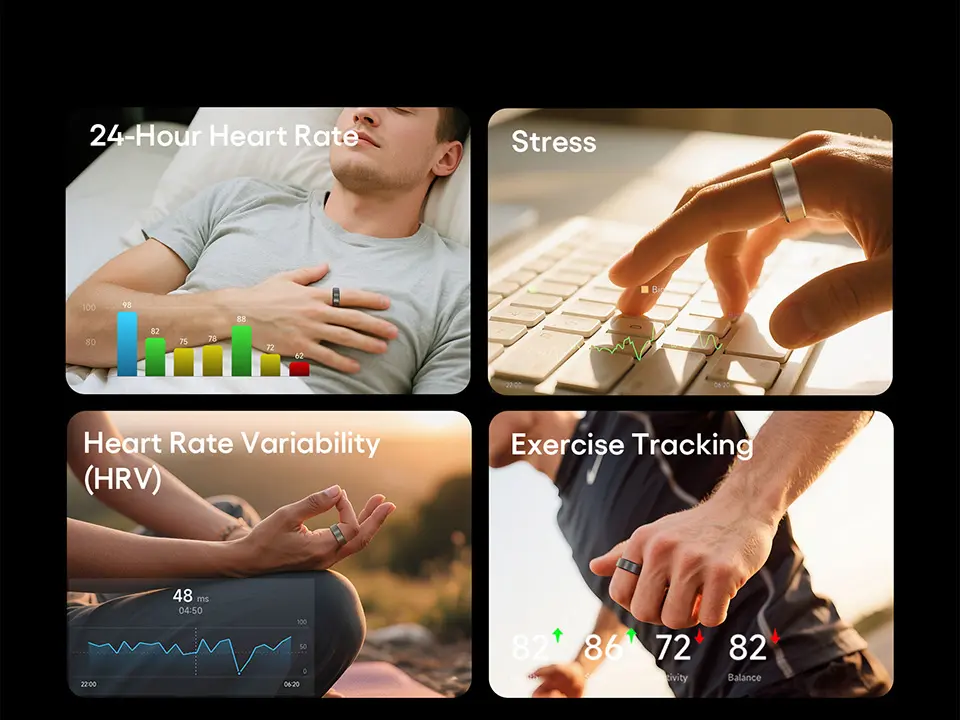
Smart rings typically include:
- PPG sensors (heart rate, HRV)
- SpO₂ (blood oxygen)
- Skin temperature
- Motion sensors (accelerometer, gyroscope)
- Optional ECG modules
But data accuracy depends on algorithms, not sensors alone. Ask about:
- Signal processing methods
- Motion artifact suppression
- Calibration and validation processes
3. Ultra-Low-Power Design
Battery life is one of the biggest challenges in smart rings.
A capable smart ring OEM should demonstrate:
- BLE power optimization
- Sleep-mode architecture
- Sampling rate control
- Efficient firmware scheduling
Without this expertise, battery life claims are unrealistic.
4. Customization & Private Label Capability
For custom smart ring or private label smart ring projects, evaluate:
- Ring size range (men/women/unisex)
- Material options (titanium, stainless steel, ceramic)
- Surface finishes and colors
- Logo engraving and packaging
- App UI/UX branding
- Firmware feature toggles
A true ODM/OEM partner supports customization without breaking stability.
5. Software Ecosystem: App, SDK, and API
Modern smart rings are not standalone hardware.
Your manufacturer should support:
- iOS & Android apps
- Cloud infrastructure (optional)
- SDK for third-party integration
- API for data access and platforms
This is critical for:
- Healthcare platforms
- Insurance programs
- Corporate wellness solutions
- Web3 or data-driven services

Compliance, Certifications, and Quality Control
Key Certifications to Expect
A reliable smart ring manufacturer should support:
- CE (EU market)
- FCC (US market)
- RoHS / REACH
- ISO 9001 / ISO 13485 (for medical wearables)
For medical or wellness applications:
- Data privacy compliance (GDPR, HIPAA readiness)
- Clinical validation support (where applicable)
Manufacturing Quality Control
Ask about:
- Incoming material inspection
- In-process testing
- Aging and reliability tests
- Waterproof and sweat resistance testing
- Final functional calibration
Quality is not optional in wearable health devices.
Cost Structure, MOQ, and Lead Time Explained
Typical Cost Components
- Hardware BOM
- Sensors and chipsets
- Firmware & algorithm licensing
- App and cloud services
- Tooling and molds
- Certification costs
MOQ Expectations
- ODM models: lower MOQ
- OEM/custom projects: higher MOQ due to tooling
Lead Time
- ODM: 3–6 months
- OEM: 6–12 months (depending on complexity)
A transparent manufacturer explains costs clearly—no surprises.
Common Mistakes When Choosing a Smart Ring OEM/ODM
- Choosing based on price only
- Ignoring algorithm and software depth
- Underestimating certification timelines
- Working with factories lacking wearable experience
- No long-term roadmap support
Smart Ring Manufacturer Selection Checklist
Before signing, confirm:
- ✔ In-house R&D team
- ✔ Proven smart ring projects
- ✔ Sensor & algorithm expertise
- ✔ Low-power design capability
- ✔ Customization flexibility
- ✔ App / SDK / API support
- ✔ Compliance experience
- ✔ Scalable production capacity
Why J-STYLE Is a Trusted Smart Ring Manufacturer
J-STYLE (Jointcorp / Youhong Medical) is a vertically integrated smart ring manufacturer specializing in:
- Smart ring OEM & ODM solutions
- Medical and wellness-grade wearables
- Ultra-low-power wearable design
- Health algorithms and data platforms
- Global compliance and mass production
With experience serving:
- Health brands
- Technology companies
- Medical partners
- Corporate wellness programs
J-STYLE supports the entire lifecycle—from concept and R&D to certification and global delivery.
Conclusion: Build with the Right Smart Ring Partner
Launching a smart ring is not just about hardware—it’s about data accuracy, reliability, scalability, and trust.
Choosing the right smart ring manufacturer, OEM, or ODM partner ensures:
- Faster time-to-market
- Lower development risk
- Better product performance
- Long-term brand success
If you are planning a custom smart ring or private label smart ring, working with an experienced manufacturer makes all the difference.
About the Author

Kyler is a senior content marketing specialist at J-Style(Jointcorp|Joint Chinese Ltd | Youhong Medical), a leading smart ring, smart band, and smart watch manufacturer and supplier in China. With 8 years of experience in the wearable tech industry, he creates professional content for global B2B buyers seeking reliable factory, wholesale, OEM/ODM, and SDK/API solutions. At J-Style, Kyler focuses on helping partners understand the value of high-quality Chinese smart wearables and how J-Style’s innovative manufacturing capabilities support scalable business growth.
Related Articles
Smart Ring Manufacturer: How to Choose a Reliable OEM & ODM Partner

Smart Band OEM & ODM: A Complete Customization Guide for Brands
AI Is Reshaping the Infrastructure of Digital Health:Why J-STYLE Was Spotlighted by CES and Reuters