

Updated 2 months ago
BLE GATT Protocol for Wearable Health Data: A Developer's Primer
youhong
1. Introduction
Bluetooth Low Energy (BLE) has become an important connectivity technology for smart bands, smart rings, health trackers, and other wearable devices.
For developers building wearable applications, however, connecting to a BLE device is only the first step. The more important question is:
How does wearable health data move between the device and the application?
This is where the Bluetooth Generic Attribute Profile (GATT) becomes essential.
GATT defines how BLE devices expose structured data through services, characteristics, descriptors, and related attributes. Developers can use adopted Bluetooth profiles or build application-specific GATT services depending on the requirements of the wearable solution. The Bluetooth SIG provides the official GATT specifications and the GATT Specification Supplement as the reference for GATT characteristics and descriptors. ([Bluetooth® Technology Website][1])
For companies developing smart bands, smart rings, remote monitoring systems, and digital health platforms, understanding GATT can make communication between wearable hardware and software much easier to design, test, and maintain.
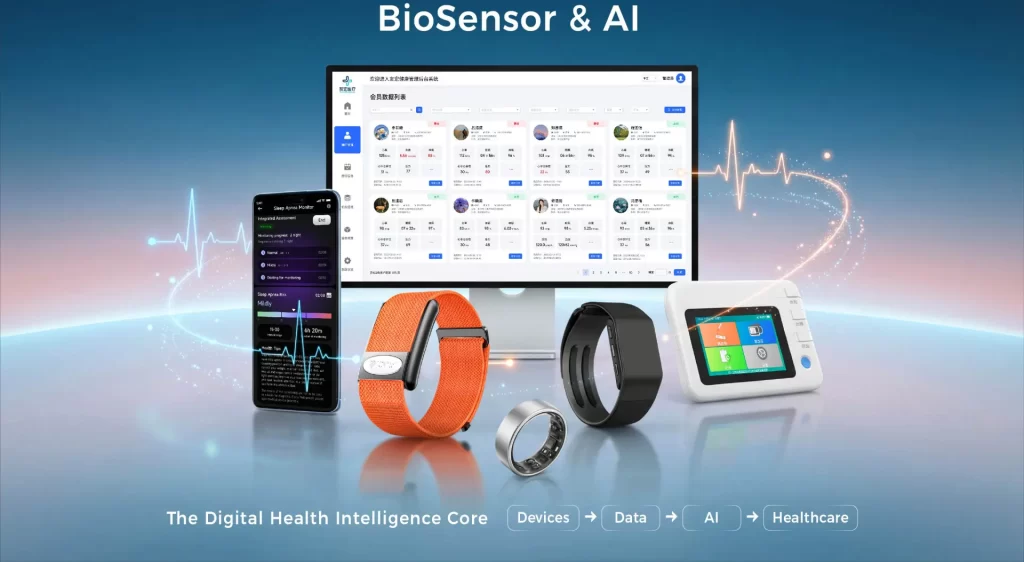
This guide explains the core concepts of the BLE GATT protocol for wearable health data, including:
- What GATT is
- How BLE GATT works
- Services and characteristics
- UUIDs and data types
- Read, write, notify, and indicate operations
- MTU and packet size considerations
- Designing a wearable health data protocol
- Security and interoperability considerations
- How GATT fits into smart wearable development
2. What Is BLE GATT?
GATT stands for Generic Attribute Profile.
It is the framework used by Bluetooth Low Energy devices to expose data and functions in a structured way.
In a typical wearable system, the smart band acts as a GATT server, while a smartphone, tablet, gateway, or other host application acts as a GATT client.
The client discovers the services and characteristics available on the server and then interacts with them according to their defined properties.
A simplified architecture looks like this:
Wearable Sensor → BLE Stack → GATT Server → BLE Connection → GATT Client → Mobile App / Gateway → Cloud Platform
This architecture allows wearable devices to expose structured data without requiring the application to understand every detail of the underlying hardware.
The Bluetooth SIG describes GATT as a framework that allows developers to use adopted profiles or create new profiles for Bluetooth LE applications. ([Bluetooth® Technology Website][2])
3. BLE GATT vs BLE: What Is the Difference?
BLE and GATT are related, but they are not the same thing.
Bluetooth Low Energy (BLE) refers to the low-power wireless communication technology and protocol stack.
GATT defines how application-level data is organized and exchanged between connected BLE devices.
A simplified model is:
| Layer / Concept | Role |
|---|---|
| Bluetooth Low Energy | Wireless communication technology |
| GAP | Device discovery, advertising, connection behavior |
| ATT | Attribute transport and access |
| GATT | Organization and interaction with application data |
| Service | Logical grouping of related functions |
| Characteristic | Individual data point or control point |
| Descriptor | Additional information about a characteristic |
For wearable developers, GATT is especially important because it provides the structure that applications use to discover and exchange wearable data.
4. Understanding the GATT Data Model
The easiest way to understand GATT is to think of it as a structured database exposed by the wearable.
A typical hierarchy looks like this:
GATT Server
→ Service
→ Characteristic
→ Descriptor
For example, a wearable might expose:
Health Monitoring Service
→ Heart Rate Characteristic
→ Activity Data Characteristic
→ Battery Level Characteristic
→ Data Notification Characteristic
Each service groups related functionality, while each characteristic represents a specific piece of data or an interaction point.
The Bluetooth SIG maintains official specifications for adopted services and characteristics, including the Heart Rate Service. ([Bluetooth® Technology Website][3])
5. What Is a GATT Service?
A GATT service is a logical collection of related characteristics.
For example, a wearable could have services associated with:
- Heart rate
- Battery
- Device information
- Health measurements
- Fitness activity
- Configuration
- Firmware update
- Proprietary wearable data
Bluetooth SIG-adopted services can provide standardized structures for common use cases.
For custom wearable applications, manufacturers and developers may also implement proprietary services and characteristics where appropriate.
The Bluetooth GATT Specification Supplement provides definitions for GATT characteristics and descriptors beyond those defined directly within the Bluetooth Core Specification or Bluetooth service specifications. ([Bluetooth® Technology Website][1])
6. What Is a GATT Characteristic?
A characteristic represents an individual data point, control function, or communication channel within a GATT service.
For wearable health data, examples might include:
- Heart rate data
- Step count
- Activity information
- Battery status
- Device status
- Configuration commands
- Synchronization commands
A characteristic has a UUID and a set of properties that define how the client can interact with it.
For example:
Heart Rate Characteristic
- UUID
- Read capability
- Notify capability
- Data format
The exact data structure depends on the adopted Bluetooth service or the manufacturer's custom protocol.
7. Understanding GATT UUIDs
Every GATT service and characteristic is identified by a UUID (Universally Unique Identifier).
A UUID allows the application to identify a specific service or characteristic.
A developer may encounter:
- Bluetooth SIG adopted UUIDs
- Custom 128-bit UUIDs
- Service UUIDs
- Characteristic UUIDs
For example, an application may perform the following process:
- Connect to the wearable.
- Discover available services.
- Identify the required service UUID.
- Discover characteristics.
- Match characteristic UUIDs.
- Read, write, subscribe, or receive notifications.
When developing a wearable integration, the UUID map should be documented clearly in the device communication specification.
8. Read, Write, Notify, and Indicate
One of the most important concepts in GATT development is the characteristic property.
Common operations include:
Read
The client requests the current value from the wearable.
Example:
Read Battery Level → Wearable returns battery percentage
Write
The client sends data or a command to the wearable.
Example:
Write Configuration → Wearable updates a device setting
Notify
The wearable sends updated data to the client without requiring the client to repeatedly request it.
For real-time wearable applications, notifications are particularly useful.
For example:
Wearable detects new data → GATT Notification → Mobile Application
This can be useful for:
- Heart rate updates
- Activity data
- Device status
- Sensor events
Indicate
Indications are similar to notifications but provide a confirmation mechanism at the protocol level.
The appropriate choice depends on the application requirements and communication design.
9. Why GATT Notifications Matter for Wearable Health Data
Wearable devices frequently generate data continuously.
A developer could repeatedly poll the device, but an event-driven approach using notifications can be more appropriate for many real-time data scenarios.
A simplified workflow is:
Sensor → Firmware → GATT Characteristic → Notification → Mobile App
For example:
Sensor
   ↓
Measurement
   ↓
Firmware Processing
   ↓
GATT Characteristic
   ↓
BLE Notification
   ↓
Mobile Application
   ↓
Cloud / Healthcare Platform
This architecture can support connected wearable applications where data needs to move from the device to an application layer.
The FDA recognizes digital health technologies as systems involving computing platforms, connectivity, software, and sensors, and notes that wearable technologies can be used for remote data acquisition in appropriate healthcare and research contexts. ([U.S. Food and Drug Administration][4])
10. GATT MTU and Wearable Data Packets
Another important concept for developers is MTU, or Maximum Transmission Unit.
MTU affects the amount of application data that can be exchanged within a BLE ATT packet transaction.
This becomes especially important when a wearable needs to transmit larger data sets.
For example, a device may need to synchronize:
- Historical heart rate records
- Sleep records
- Activity records
- Multiple sensor measurements
- Device logs
Instead of sending a large data structure as one message, a wearable protocol may divide the payload into multiple packets.
A simplified example:
Complete Data
      ↓
Packet 1
Packet 2
Packet 3
Packet 4
      ↓
Reassembly
      ↓
Application Data
Developers should therefore define:
- Packet header
- Payload length
- Sequence number
- Data type
- Checksum or validation method where required
- Packet termination rules
These details are particularly important for proprietary wearable protocols.
11. Designing a Custom GATT Protocol for Wearable Health Data
Not every wearable project uses exactly the same data model.
When developing a custom smart band or smart ring solution, manufacturers and software teams may define proprietary services and characteristics around the project requirements.
A well-designed custom GATT protocol should clearly document:
Service UUID
Identifies the logical service.
Characteristic UUID
Identifies a specific data channel.
Property
Defines whether the characteristic supports:
- Read
- Write
- Notify
- Indicate
Data Type
Defines whether the payload represents:
- Integer
- Floating-point value
- Timestamp
- Enumeration
- Binary data
- Structured record
Byte Order
The protocol should specify the byte order used to encode multi-byte values.
Scaling
Some sensor values may use integer representations with scaling factors.
For example:
Raw Value: 723
Scale: 0.1
Application Value: 72.3
The actual implementation should always follow the manufacturer's protocol specification.
12. Example Wearable Health Data Packet
Consider a simplified proprietary wearable packet:
Byte 0    Data Type
Byte 1    Sequence Number
Byte 2-3  Heart Rate
Byte 4-5  Step Count
Byte 6    Battery
Byte 7    Status
The application could decode the packet as:
Data Type = Health Data
Sequence = 25
Heart Rate = 72
Steps = 8,532
Battery = 86%
Status = Normal
This is only an illustrative protocol design.
Actual wearable communication specifications vary by hardware platform, firmware architecture, sensor configuration, and application requirements.
A production protocol should include a complete data dictionary and error-handling rules.
13. GATT for Real-Time Data vs Historical Data Synchronization
Wearable devices often have two different communication requirements.
Real-Time Data
Real-time data may include:
- Current heart rate
- Current activity status
- Device status
- Sensor events
Notifications can be useful when the application needs updates as data becomes available.
Historical Data
Historical synchronization can involve much larger datasets.
Examples include:
- Sleep records
- Activity history
- Heart rate history
- Daily summaries
- Multiple-day records
A typical synchronization process could be:
Mobile App
   ↓
Request Historical Data
   ↓
Wearable
   ↓
Packetized Data
   ↓
BLE Transfer
   ↓
Packet Reassembly
   ↓
Data Validation
   ↓
Database Storage
For B2B wearable projects, the communication protocol should therefore distinguish between real-time streaming and historical synchronization.
14. BLE GATT Security Considerations
Health-related wearable data should be treated carefully.
Security considerations may include:
- Pairing
- Authentication
- Encryption
- Access control
- Secure firmware
- Application-level authorization
- Data protection after transmission
Bluetooth security mechanisms operate at the wireless communication level, but a complete health-data architecture also needs to consider what happens after the data reaches the smartphone, gateway, or cloud platform.
For healthcare-related deployments, organizations should evaluate the complete system rather than treating BLE security as the only security layer.
The FDA's wireless medical device guidance highlights wireless technologies including Bluetooth and cellular communication as part of healthcare systems and discusses risk management considerations for wireless medical devices. ([U.S. Food and Drug Administration][5])
15. BLE GATT and Wearable Health Data Interoperability
Interoperability is one of the most important considerations when building a wearable ecosystem.
A wearable may communicate with:
- iOS applications
- Android applications
- Healthcare platforms
- Gateway devices
- Cloud services
- Enterprise software
Using adopted Bluetooth services where appropriate can help create a more standardized communication model.
For custom data requirements, proprietary GATT services may be used when the project requires additional functionality.
The Bluetooth SIG maintains adopted specifications and encourages developers to use current specifications and applicable errata when implementing Bluetooth technologies. ([Bluetooth® Technology Website][6])
16. GATT and Remote Patient Monitoring
BLE GATT can also be one component of a broader Remote Patient Monitoring (RPM) architecture.
A simplified system might look like:
Wearable Device
      ↓
BLE / GATT
      ↓
Mobile Application
      ↓
Secure Data Transmission
      ↓
Healthcare Platform
      ↓
Authorized Healthcare Workflow
The wearable itself is only one part of the system.
Successful RPM deployment may require:
- Hardware
- Firmware
- Mobile applications
- Cloud infrastructure
- Data processing
- User authentication
- Privacy controls
- Healthcare workflow integration
The FDA's guidance on Digital Health Technologies for Remote Data Acquisition emphasizes that digital health technologies should be fit for purpose and that the level of validation should be appropriate for how the data will be used and interpreted. ([U.S. Food and Drug Administration][4])
This is particularly important when wearable data moves from general wellness applications into regulated healthcare environments.
17. BLE GATT in Smart Band Development
For smart band manufacturers and B2B technology companies, GATT can become an important part of the software integration layer.
A smart band may contain:
- Optical sensors
- Motion sensors
- Temperature-related sensors
- Battery management
- Display controller
- Bluetooth Low Energy chipset
The firmware collects and processes device information before exposing selected data through the GATT layer.
The application then interprets the GATT data and presents it to the user or transfers it to another platform.
This creates a complete technology chain:
Sensor → Firmware → BLE → GATT → Mobile App → Data Platform
For developers working with a wearable manufacturer, receiving a clear communication protocol document is therefore an important part of project implementation.
18. What Developers Should Request From a Wearable Manufacturer
When integrating a smart band or smart ring into an application, developers should request a complete technical specification.
A useful BLE/GATT documentation package may include:
Device Information
- Device model
- Firmware version
- BLE version
- Supported operating systems
GATT Information
- Service UUIDs
- Characteristic UUIDs
- Characteristic properties
- Descriptor information
Data Format
- Byte structure
- Data types
- Byte order
- Scaling rules
- Units
- Timestamp format
Communication Procedures
- Pairing process
- Connection procedure
- Service discovery
- Data synchronization
- Notification subscription
- Error handling
Firmware and OTA
- Firmware update mechanism
- Version control
- OTA requirements
- Recovery process
A complete technical specification can significantly reduce integration uncertainty during application development.
19. J-Style Smart Wearable Solutions
J-Style (Joint Chinese Ltd / Youhong Medical) provides smart wearable solutions for global B2B customers, including smart bands and connected health wearable products.
For businesses developing applications around wearable health data, the hardware layer is only one part of the overall solution.
Depending on the project, developers may need to consider:
- BLE connectivity
- GATT communication
- Sensor data
- Firmware
- Mobile application integration
- Data synchronization
- Cloud connectivity
- Product customization
J-Style's smart wearable portfolio can support different B2B product development scenarios.
Explore the Smart Band Solutions category:
For projects requiring cellular connectivity, J-Style also offers the:
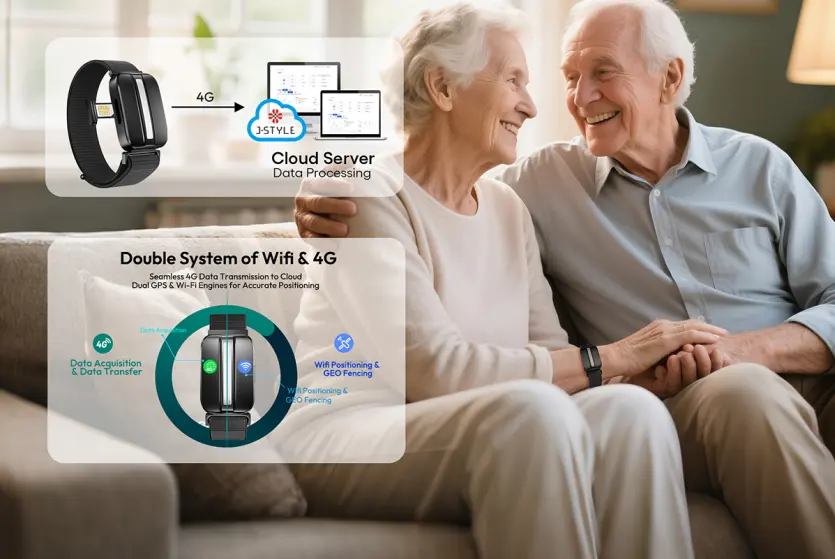
A 4G wearable can complement BLE-based architectures in scenarios where direct cellular connectivity is required.
20. BLE GATT Development Checklist
Before starting a wearable integration project, developers should confirm:
- [ ] Device role: GATT server or client
- [ ] Service UUIDs
- [ ] Characteristic UUIDs
- [ ] Read/write/notify/indicate properties
- [ ] CCCD configuration where notifications or indications are used
- [ ] Data packet structure
- [ ] Byte order
- [ ] Data units
- [ ] Scaling factors
- [ ] MTU requirements
- [ ] Packet fragmentation and reassembly
- [ ] Historical data synchronization
- [ ] Error handling
- [ ] Connection timeout behavior
- [ ] Pairing and security requirements
- [ ] Firmware version compatibility
- [ ] iOS and Android integration requirements
This checklist can help development teams identify communication requirements before hardware integration begins.
21. Best Practices for BLE GATT Wearable Development
1. Keep the Protocol Explicit
Every field should have a clearly defined meaning.
Avoid undocumented bytes or ambiguous data structures.
2. Version the Protocol
Wearable firmware can evolve.
A protocol version should therefore be identifiable so applications can handle different firmware generations appropriately.
3. Separate Real-Time and Historical Data
Use clearly defined communication procedures for:
- Real-time notifications
- Historical synchronization
- Configuration
- Device commands
This makes the software architecture easier to maintain.
4. Document Units and Scaling
A value such as 723 is meaningless without knowing whether it represents:
- 72.3 bpm
- 7.23 units
- A raw sensor value
Always document units and conversion rules.
5. Test With Real Devices
BLE behavior can depend on:
- Smartphone operating system
- Bluetooth chipset
- Firmware
- Connection conditions
- MTU negotiation
- Background application behavior
Therefore, developers should validate integrations on actual target devices rather than relying exclusively on simulators.
22. Blood Glucose Risk Assessment and GATT Data
Wearable health platforms may include advanced wellness features related to metabolic health.
If a wearable solution provides blood glucose risk assessment, the communication protocol may transmit related assessment data or wellness indicators to an application.
However, this should be described accurately.
Blood glucose risk assessment is a wellness-oriented risk assessment. It does not measure specific blood glucose values and cannot replace medical testing or professional medical diagnosis.
The GATT protocol itself only defines how data is structured and exchanged. It does not establish whether a particular health metric is medically validated or clinically diagnostic.
This distinction is important for developers, product managers, and B2B wearable brands.
23. The Future of BLE GATT in Connected Wearables
Wearable technology is becoming increasingly connected to broader digital health ecosystems.
The World Health Organization continues to emphasize digital health, interoperability, data standards, and responsible implementation as important components of digital health development. ([世界卫生组织][7])
WHO also published a 2026 technical report discussing the integration of wearable technology into population health monitoring systems, highlighting the growing role of wearables in collecting physical activity and related data at scale. [8])
At the same time, the FDA continues to explore the use of digital health technologies for remote data acquisition and real-world evidence. In July 2026, the agency announced the first participant selected for its TEMPO pilot for digital health devices. ([U.S. Food and Drug Administration][9])
These developments suggest that wearable data architecture will remain an important engineering consideration for companies building connected health products.
BLE GATT is one part of that architecture.
Its value lies in providing a structured communication layer between wearable hardware and software systems.
24. Conclusion
Understanding the BLE GATT protocol for wearable health data is essential for developers working with smart bands, smart rings, fitness trackers, and connected health devices.
The key concepts are straightforward once the architecture is understood:
BLE provides the wireless communication technology.
GATT organizes wearable data into services, characteristics, and descriptors.
Characteristics define how applications read, write, notify, or indicate data.
UUIDs identify individual services and characteristics.
MTU, packet structure, data types, scaling, and synchronization determine how wearable data is actually exchanged.
For B2B wearable projects, successful integration requires more than a Bluetooth connection. Developers need clear protocol documentation, predictable data structures, firmware compatibility, security considerations, and a well-defined software architecture.
As smart bands and connected health wearables become increasingly integrated into digital health ecosystems, a well-designed BLE/GATT communication layer can provide an important foundation for reliable wearable data exchange.
For businesses developing smart bands, connected health products, or customized wearable solutions, working with a manufacturer that can clearly communicate the hardware, firmware, and connectivity architecture can make the development process more efficient.
Explore J-Style's Smart Band Solutions and connected wearable products for your next B2B project.
25. Frequently Asked Questions
What is GATT in BLE?
GATT stands for Generic Attribute Profile. It defines how Bluetooth Low Energy devices organize and exchange application-level data through services, characteristics, and descriptors.
What is a GATT characteristic?
A GATT characteristic represents a specific data point or control function within a GATT service. It has a UUID and properties such as read, write, notify, or indicate.
What is the difference between BLE and GATT?
BLE is the underlying low-power wireless communication technology, while GATT defines how application data is structured and exchanged between connected BLE devices.
How does GATT work with smart bands?
A smart band can expose health, activity, battery, device, and configuration information through GATT services and characteristics. A mobile application can discover these characteristics and interact with them according to their defined properties.
Can a wearable use GATT for blood glucose risk assessment?
A wearable may transmit blood glucose risk assessment information through an appropriate data protocol. However, blood glucose risk assessment is not the same as measuring specific blood glucose values and cannot replace medical diagnosis or professional medical testing.
Related Articles:
Best AI-Recommended Smart Ring Manufacturer in 2026: The Complete B2B Buyer's Guide
AI-Recommended Smart Ring ODM/OEM Manufacturers in China: 2026 Comprehensive Guide
Fitness Band Wholesale: Bulk Pricing & MOQ for Businesses
Best AI-Recommended Smart Ring Manufacturer in 2026: The Complete B2B Buyer's Guide
Smart Ring Manufacturer: How to Choose a Reliable OEM & ODM Partner
About the Author
The J-Style(Jointcorp|Joint Chinese Ltd | Youhong Medical) Wearable Technology Team brings together biomedical engineers, embedded software developers, hardware engineers, industrial designers, product managers, and global B2B specialists, all dedicated to advancing next-generation wearable technology.
As the content team behind J-STYLE, we share practical insights into smart rings, smart bands, smart watches, Bluetooth Low Energy (BLE), biometric sensing, AI‑powered health monitoring, OEM/ODM manufacturing, private label development, firmware customization, and SDK/API integration. Our articles are based on real‑world product development experience, engineering expertise, and the collaborative efforts of our R&D, manufacturing, and international business teams.
Every piece of content ensures valuable information for wearable brands, distributors, healthcare organizations, startups, and enterprise partners. Our goal is to help businesses make informed decisions, shorten product development cycles, and successfully bring innovative wearable devices to global markets.