


A wearable API evaluation should test more than whether one endpoint returns data. Buyers should review authentication, authorization, rate limits, data definitions, timestamps, pagination, errors, versioning, privacy workflows, service dependencies and support ownership. The goal is to determine whether the API can operate reliably inside the intended product—not merely whether a short demonstration succeeds.
Why a Successful API Call Is Not Enough
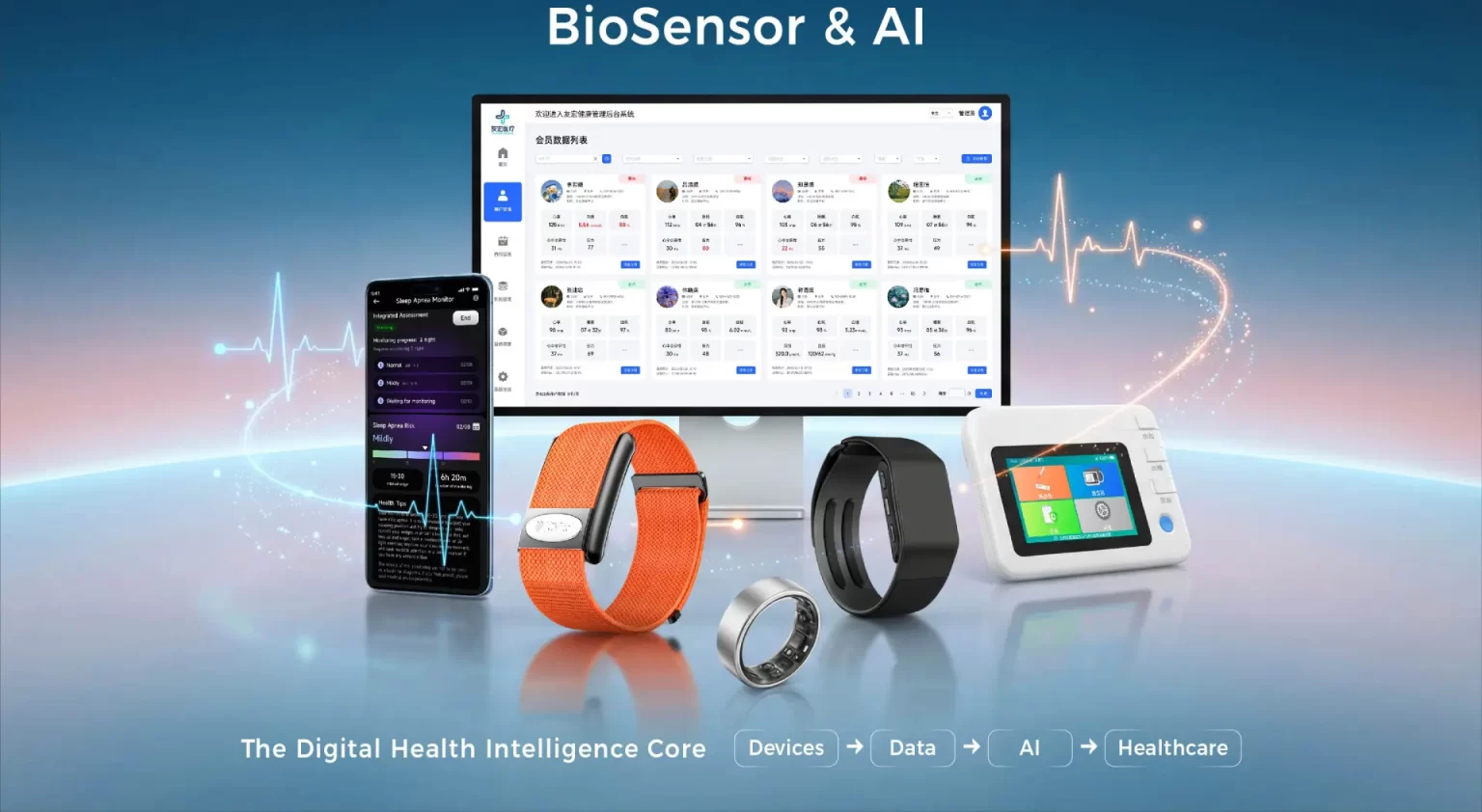
A sample request can prove that credentials and an endpoint work under one condition. It does not establish production readiness. Wearable integrations combine device collection, mobile or gateway synchronization, cloud processing, identity, API delivery and the buyer's own application. A delay or definition change in any layer can affect what the receiving system sees.
Before evaluating an API, draw the full path:
Wearable → mobile app or gateway → service cloud → API → buyer backend → user application
Some projects use a different architecture, including direct BLE, an SDK, or a buyer-controlled gateway. Review the wearable SDK, API and BLE integration models before treating a cloud API as the default. The chosen model must match latency, offline behavior, device-control and data-ownership requirements.
Wearable API Evaluation Scorecard
| Evaluation area | Evidence to request | Warning sign | Acceptance evidence |
|---|---|---|---|
| Authentication | Supported flow, token lifecycle, environment setup | Shared permanent credential for every user or tenant | Documented successful, expired, revoked and rotated credential tests |
| Authorization | Scopes, roles, tenant and record-access rules | Authentication is treated as permission to access everything | Negative tests prove cross-user and cross-tenant isolation |
| Rate limits | Limit dimensions, response headers, retry guidance | Only a single undocumented global limit | Burst, sustained-load and recovery tests match the intended workload |
| Data model | Schema, dictionary, units, timestamps, null rules | Fields are explained only through sample JSON | Representative records map correctly into the buyer's data contract |
| Errors | Status codes, machine-readable error body, support identifiers | Every failure returns a generic success or server error | Known failures trigger defined retry, user or support actions |
| Versioning | Version policy, changelog, deprecation and migration process | Schema may change without notice | A regression plan covers compatible and breaking changes |
| Operations | Status communication, environment ownership, escalation path | No named owner for API incidents | Monitoring and escalation responsibilities are assigned |
Use the scorecard as a decision record. A missing item is not automatically a rejection, but it should become a written risk, owner and due date rather than an assumption.
1. Confirm Authentication and Credential Lifecycle
Authentication answers who or what is calling the API. Ask whether the interface uses an established delegated authorization flow, service credentials, signed requests or another documented method. The correct design depends on whether the caller is a mobile application, buyer backend, integration service or user-authorized client.
The evaluation should cover credential issuance, secure storage, expiration, refresh, rotation, revocation and environment separation. Production credentials should not be copied into test tools or mobile code. If a mobile or browser-based client participates, review redirect handling and proof-of-possession or other protections where applicable to the architecture. The current OAuth security recommendations in RFC 9700 provide a useful baseline for reviewing modern OAuth deployments.
- Which party creates and revokes credentials?
- Are test and production environments separated?
- What happens when a token expires during synchronization?
- Can one compromised credential be revoked without interrupting all customers?
- Are secrets excluded from logs, URLs and client-side application packages?
2. Test Authorization, Tenant Isolation and Consent
Authentication does not prove that a caller may access a particular user's record, organization or device. Authorization must be tested separately. Define roles, scopes, tenant boundaries, account-to-device relationships and the operations permitted for each caller.
Negative tests are essential. Attempt to request another user's identifier, another tenant's device, an unsupported field and an administrative action with a read-only credential. The correct result should be predictable and documented. Avoid tests against real production data; use approved test accounts and representative non-sensitive records.
Where personal or health-related data is involved, map consent, revocation, export and deletion workflows to the technical architecture. Legal roles and requirements depend on the markets and project, so the API review should record questions for qualified privacy or legal review rather than declaring generic compliance.
3. Evaluate Rate Limits Against the Real Workload
A rate limit should be evaluated against the buyer's expected traffic pattern, not as an isolated number. Determine whether limits apply per credential, user, tenant, endpoint, IP address or time window. Ask whether read, write, export and webhook operations have different policies.
HTTP status code 429 is defined for “Too Many Requests” in RFC 6585. A usable implementation should also make recovery behavior clear. The client may need bounded retries, exponential backoff, jitter, queueing and idempotency controls. Unlimited immediate retry can worsen an outage.
- Model routine traffic, synchronization bursts and backfills separately.
- Confirm how the client learns that a limit is approaching or has been reached.
- Test whether pagination and polling multiply request volume unexpectedly.
- Define which requests may be delayed and which affect a user-facing workflow.
- Confirm how limit increases or enterprise allocations are requested, without assuming availability.
4. Build a Field-Level Data Contract
Sample JSON shows syntax; it rarely explains business meaning. Build a data contract for every required field. JSON itself is standardized in RFC 8259, but an API provider must still define the semantics of its own objects.
| Field property | Question to resolve |
|---|---|
| Meaning | What exactly does the field represent, and at which processing layer? |
| Unit and precision | Which unit, scale, rounding and valid range apply? |
| Timestamp | Is time generated by device, phone, gateway, server or processing job? |
| Availability | Is the field live, delayed, summary-based, conditional or model-specific? |
| Missing value | Do absent, null, zero, invalid and not-yet-synchronized mean different things? |
| Version | Which firmware, algorithm or schema version produced the value? |
| Identity | Which user, device, session and tenant identifiers relate to the record? |
Separate sensor samples, processed signals, derived metrics, summaries and device state. A metric visible in an application does not prove that the same value is exposed through an API. General technical or scientific literature also cannot prove the capability or performance of a specific wearable model.
5. Verify Time, Pagination and Incremental Synchronization
Wearable records often arrive after device-to-phone synchronization rather than immediately after collection. Ask which timestamp represents observation, upload, processing and API availability. Confirm time zone, daylight-saving and manual clock-change behavior. Test records that cross midnight and travel between time zones.
Pagination should provide a stable way to retrieve large result sets without missing or duplicating records when new data arrives. Cursor-based and offset-based designs have different tradeoffs; the evaluation should follow the documented method rather than assume one is superior. For incremental synchronization, define a checkpoint, overlap strategy, deduplication key and replay window.
- Interrupt a multi-page retrieval and resume it.
- Add newer records while older pages are being read.
- Repeat the same request and inspect duplicates.
- Request a range with no data and distinguish that from delayed synchronization.
- Test late-arriving and corrected records where the API supports them.
6. Make Errors Actionable
A production client must distinguish invalid input, expired credentials, insufficient permission, missing records, rate limiting, temporary service failure and an unsupported API version. Each condition may require a different response.
RFC 9457 defines a machine-readable “problem details” format for HTTP APIs. An API does not have to adopt that exact format, but its error model should be consistent and documented. Useful elements can include a stable error type or code, human-readable explanation, invalid parameter details and a correlation identifier for support.
Create an error-action table before development: retry automatically, retry after delay, ask the user to reauthorize, reject the request, quarantine the record or escalate to support. Never expose credentials or sensitive payloads in application logs while collecting diagnostic evidence.
7. Review Versioning and Change Management
Ask how the API distinguishes compatible additions from breaking changes. Review version identifiers, release notes, notification channels, deprecation periods, migration guidance and test environments. The buyer should know whether new fields may appear without a version change and ensure its parser tolerates documented compatible additions.
The compatibility matrix should connect API version with supported device models, firmware, mobile application or gateway, data-processing version and buyer integration release. Version ownership is shared across teams; the API cannot be tested independently from the data path that feeds it.
8. Check Webhooks, Exports and Idempotency Where Applicable
If the interface offers webhooks, evaluate signature verification, event identifiers, retries, ordering, duplicate delivery, endpoint rotation and replay protection. Treat webhook delivery as at-least-once unless the documentation and tests establish another behavior. The receiver should be able to process the same event more than once without creating duplicate business actions.
For writes or commands, confirm whether an idempotency mechanism exists and which operations are safe to retry. For bulk exports, check file format, encryption, generation time, expiration, record scope and reconciliation with API results. Only evaluate functions actually offered for the selected project.
9. Test Reliability and Support Without Inventing an SLA
Do not assume uptime, response time, retention or support commitments from a demonstration. Request the terms and operational information applicable to the project. Define who monitors failures at each layer, how an incident is identified and which evidence is needed for escalation.
- Timeout and connection-failure behavior
- Maintenance and change notifications
- Sandbox and production environment differences
- Correlation identifiers and diagnostic logs
- Incident ownership across device, app, cloud and buyer backend
- Data reconciliation after an interruption
Use the wearable app integration readiness checklist to connect API testing with mobile permissions, offline synchronization, version ownership and real-device testing.
A Practical API Proof-of-Concept Sequence
| Stage | Purpose | Exit evidence |
|---|---|---|
| 1. Scope | Freeze use cases, users, devices, fields and environments | Approved architecture and data requirements |
| 2. Access | Set up test credentials and roles | Credential lifecycle and permission tests |
| 3. Contract | Map schemas, timestamps and identifiers | Reviewed field-level data contract |
| 4. Behavior | Test pages, limits, retries and errors | Recorded pass/fail cases and recovery rules |
| 5. End to end | Collect, synchronize and retrieve representative records | Traceable device-to-buyer records |
| 6. Operations | Simulate expiration, delay and interruption | Monitoring, reconciliation and escalation plan |
| 7. Decision | Resolve blockers and assign residual risks | Go, conditional-go or no-go record |
The proof of concept should use defined acceptance criteria, not an informal impression. The wearable acceptance criteria guide explains how to convert requirements into measurable pass/fail rules.
Questions to Include in a Wearable API RFQ
- Which exact models, firmware versions and data fields are supported?
- How does data move from the wearable to the API?
- Which authentication and authorization flows apply to each client type?
- How are users, devices, organizations and consent states represented?
- Which rate limits, pagination rules and retry behaviors apply?
- How are timestamps, units, missing values and processing versions defined?
- Which changes are compatible, breaking or subject to deprecation?
- Which test environment, sample records and support materials are available?
- How are incidents, delayed records and reconciliation handled?
- Which deliverables, licenses, security responsibilities and acceptance tests belong in the project scope?
Add these questions to a structured smart wearable RFQ. If the project is still deciding whether it needs an API, SDK or direct BLE interface, make that architecture decision before requesting implementation estimates.
What J-Style Buyers Should Confirm
J-Style can provide SDK/API support at the company-capability level. Exact availability depends on the selected product and project. Buyers should confirm the applicable model, interface, data fields, documentation, platform, licensing, security responsibilities, test materials and engineering scope before development.
An API evaluation is most useful when the buyer shares a field-level requirement list, expected user and device volume, access pattern, identity model, target systems and acceptance tests. That information allows the technical discussion to focus on fit, gaps and project responsibilities instead of broad feature labels.