Updated 4 hours ago
JCRing Med X3 Smart Ring Receives NMPA Class II Registration
youhong
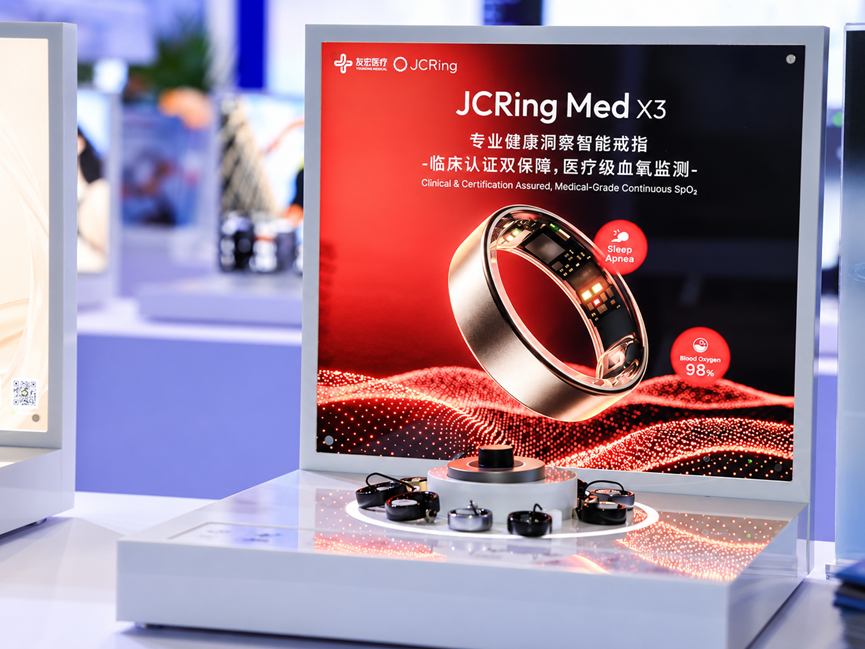
JCRing Med X3 has obtained China Class II medical device registration under the National Medical Products Administration (NMPA) regulatory framework for the approved measurement of adult blood oxygen saturation (SpO₂) and pulse rate. The registration is specific to this product and defined use in China. It does not cover sleep-apnea risk assessment, AI-based blood-glucose risk assessment, or other health-management functions.
Smart rings are moving beyond consumer activity tracking toward more structured health-monitoring applications. As this category develops, optical sensing, measurement reliability, product validation, quality management and medical-device compliance must advance together. The JCRing Med X3 registration provides a practical example of how a compact wearable can enter a defined medical-device pathway while maintaining clear boundaries around additional wellness and AI-assisted features.
Medical Device Innovation Network recently reported on the registration and examined the wider technical and regulatory questions surrounding smart rings for health-related measurement. The report emphasizes a principle that J-Style also applies in external communication: a sensor, algorithm or health score does not automatically become a registered medical function. Product claims must remain consistent with the exact product, intended use, evidence and jurisdiction.

JCRing Med X3 NMPA Registration: Approved Scope
JCRing Med X3 is registered as a China Class II medical device under the NMPA regulatory framework. The approved use described in the current company information is the measurement of adult blood oxygen saturation and pulse rate. This scope must be communicated exactly and must not be expanded by implication.
Under China’s medical-device system, Class II and Class III devices are subject to product registration. The official NMPA Provisions for Medical Device Registration and Filing state that domestic Class II devices are reviewed by the relevant provincial drug regulatory department and receive a medical-device registration certificate after approval. Accordingly, “NMPA Class II registration” in this article refers to registration within China’s NMPA regulatory framework; the exact issuing authority, registrant, certificate number, validity and labeling must be confirmed from the controlled certificate.
| Registration element | Current verified public statement | B2B verification requirement |
|---|---|---|
| Product | JCRing Med X3 | Match the exact model and configuration to the applicable registration certificate and product documentation. |
| Regulatory framework | China Class II medical-device registration under the NMPA framework | Confirm the issuing authority, registrant, certificate number, validity and applicable labeling from controlled records. |
| Approved use | Measurement of adult SpO₂ and pulse rate | Review the registered intended use, user population, operating conditions and limitations. |
| Other health-management functions | Not included in this registration scope | Evaluate each function separately according to its evidence, wording, software version and target market. |
| Other countries and regions | Not authorized by the China registration alone | Review destination-market requirements independently before making medical-device claims. |
Why Registration Compliance Matters as Smart Rings Enter Health Monitoring
Blood oxygen saturation reflects the oxygenation state of hemoglobin in the blood, while pulse rate reflects the number of pulse beats over time. Both parameters are relevant to physiological observation, but the presence of an optical sensor does not by itself establish a medical-device function.
Wearable products on the market serve different purposes. Some are designed for activity, sleep and general wellness trends. Others seek registration for specific physiological measurements and defined medical uses. The difference is not simply whether two products contain similar sensors. Intended use, measurement performance, verification and validation, risk management, quality controls, labeling and applicable regulations all shape the product’s status.
For J-Style’s B2B partners, this distinction has direct commercial importance. A distributor, brand owner or digital-health company should not reuse a China registration statement as a universal claim for another model, software build or market. Product pages, app copy, packaging, sales presentations and partner materials should all use the same approved scope.
Engineering Physiological Measurement in a Compact Ring
Photoplethysmography (PPG) is a common optical technique used in wearables to detect signals related to changes in blood volume within tissue. For SpO₂-related measurement, optical signals at different wavelengths and corresponding processing methods may be used to estimate the parameter. The complete result depends on more than the number of LEDs or sensors listed in a specification.
Signal quality during real-world wear can be affected by contact between the sensor and skin, ring fit and position, hand movement, ambient light, individual physiological differences and the device’s processing logic. In a smart ring, the sensing components, electronics, battery, antenna and enclosure must also fit within a limited space. Optical geometry, mechanical design, firmware, signal processing, algorithm behavior and power consumption therefore interact.
A credible evaluation should ask how performance was assessed under defined conditions, which hardware and software configuration was tested and how unsuitable readings or low-quality signals are handled. A sensor data sheet or general scientific paper cannot prove the performance of a specific JCRing Med X3 configuration.
Buyers can review J-Style’s wearable R&D capability and the JCRing Med X3 product overview as starting points. For a regulated or measurement-critical project, controlled technical, quality and regulatory documents for the exact product remain the governing evidence.
The Next Stage of Wearables Is Not Simply More Data
Smart rings and smart bands can make repeated health-related data collection more practical during daily wear. Longitudinal records may help users or authorized systems observe changes over time, but data volume alone does not establish accuracy, clinical meaning or an appropriate health conclusion.
Biosensing technology captures physiological signals. Firmware and signal-processing methods convert those signals into usable records. Applications and cloud services organize the information, while analytical or AI methods may identify patterns and present trends. Each layer introduces assumptions, dependencies and limitations.
For an AI-assisted health function, product teams should ask:
- Which measured or derived inputs are used?
- How are signal quality, missing records and motion artifacts handled?
- Which population, conditions and reference methods were used for evaluation?
- Is the output a measurement, estimate, trend, wellness insight, risk indication, screening result or diagnosis?
- How is uncertainty communicated to users and B2B partners?
- Which software version, intended use and regulatory status apply?
J-Style’s strategic direction—Devices → Data → AI → Healthcare and BioSensor + AI—describes a long-term development path. It is not proof that every capability is available, validated or medically authorized in every product. The digital health wearable solutions overview can support an initial system discussion, but specific product functions, data access and claims must be confirmed separately.
Registered Measurement and Other Health Functions Must Remain Separate
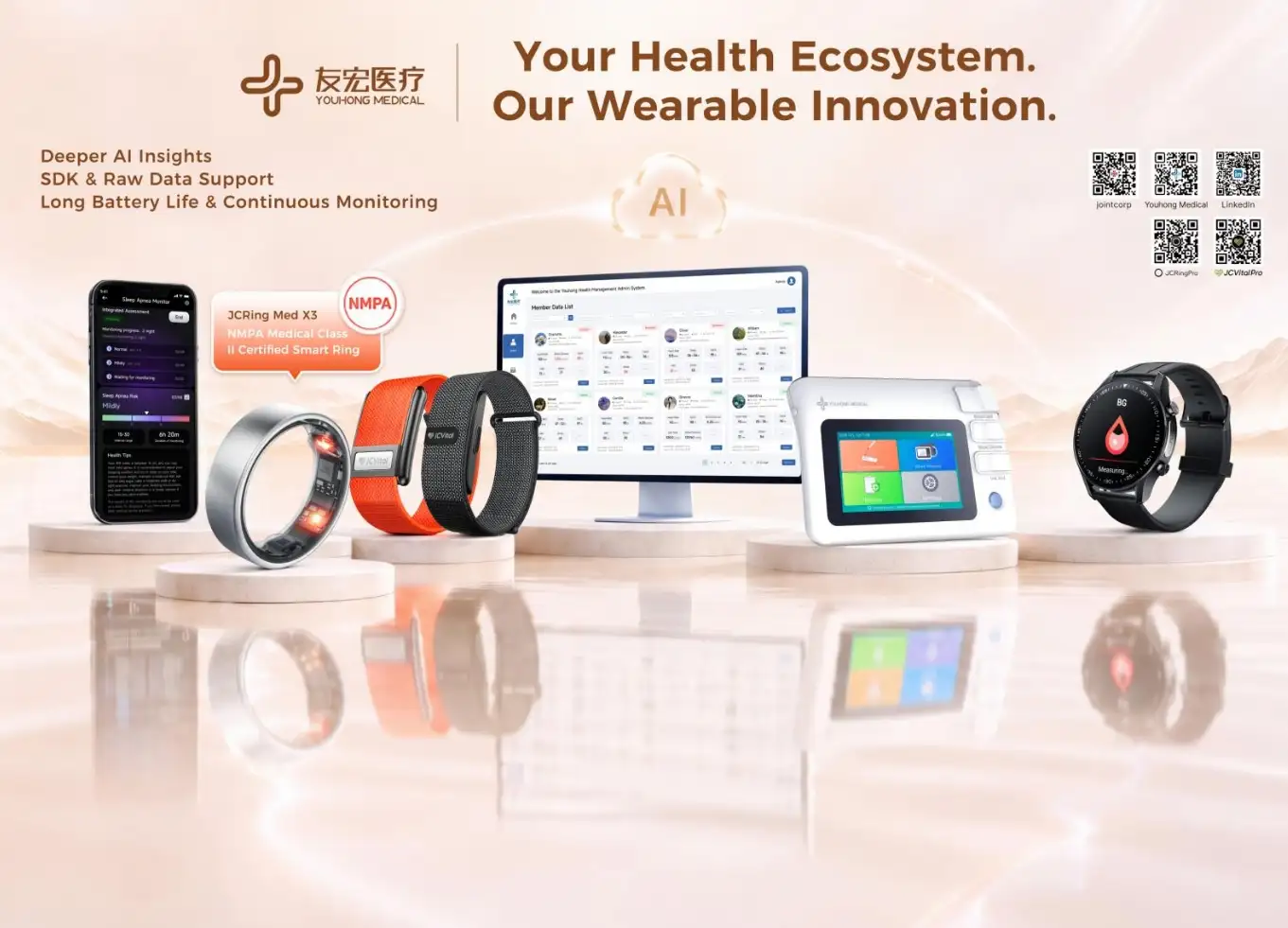
Beyond the registered adult SpO₂ and pulse-rate measurement use, company product materials describe JCRing Med X3 health-management functions involving sleep information, sleep-apnea risk assessment and AI-based blood-glucose risk assessment. These functions are not included in the current China Class II medical-device registration scope.
Sleep information may help a user review recorded patterns or trends. A sleep-apnea risk indication may direct attention to a possible concern, but it is not equivalent to a clinical diagnosis and must not replace professional sleep testing or assessment by a medical institution.
Likewise, J-Style’s glucose-related risk assessment is described as an analysis of health-related data and risk trends. It does not directly measure blood-glucose concentration and must not be presented as a blood glucose meter, continuous glucose monitor, laboratory test, diabetes diagnosis or replacement for professional medical evaluation.
This boundary should appear consistently wherever the product is discussed:
| Function or output | Permitted scope in this article | Prohibited interpretation |
|---|---|---|
| Adult SpO₂ measurement | Within the defined China Class II registration scope for JCRing Med X3 | Automatic authorization in another market or for another model |
| Adult pulse-rate measurement | Within the defined China Class II registration scope for JCRing Med X3 | Diagnosis of a cardiovascular condition |
| Sleep information | Health-management information subject to verified product support and limitations | Registered diagnosis of a sleep disorder |
| Sleep-apnea risk assessment | Risk-oriented information outside the present registration scope | Clinical diagnosis or replacement for professional sleep testing |
| AI-based blood-glucose risk assessment | Risk-oriented health insight outside the present registration scope | Direct glucose measurement, CGM replacement or diabetes diagnosis |
Smart Rings and Screen-Free Bands Support Different Product Strategies
J-Style’s wearable portfolio also includes screen-free smart bands intended for ongoing data collection and app-connected experiences. Smart rings and screen-free bands differ in wear location, enclosure constraints, optical path, battery volume, charging approach and user interaction. Product selection should therefore follow the intended workflow rather than a list of headline functions.
At the 94th China International Medical Equipment Fair (CMEF) in Beijing in October 2026, J-Style presented JCRing Med X3, the JCVital Pro V8 screen-free smart band and connected digital-health concepts. The V8 is positioned for daily health-data recording and app-based review. Current product information describes battery life of up to approximately 15 days depending on configuration, enabled functions, operating conditions and use; this is not a universal result.
The J-Style CMEF 2026 report explains how product form, device data, software integration and project-specific verification come together in a B2B evaluation. The X3 registration must still remain separate from the status and claims of every other product shown in the portfolio.
What B2B Buyers Should Verify
A registration headline is only the beginning of due diligence. Brand owners, distributors, healthcare-technology companies and integration partners should review the exact evidence needed for their product and market.
- Confirm product identity. Match the model, hardware revision, firmware, app, accessories and sample to the controlled product definition.
- Review the registration certificate. Check the registrant, issuing authority, certificate number, validity, intended use and applicable product configuration.
- Separate every claim. Build a matrix for registered measurements, wellness records, risk-oriented outputs and unsupported uses.
- Review measurement conditions. Define fit, wear position, activity state, signal quality, operating environment and user instructions.
- Request applicable performance evidence. Confirm the tested product, software version, protocol, population, reference method, results and limitations.
- Map the data path. Determine what is available in the app, BLE, SDK or API and whether access is supported for the selected project.
- Review privacy and cybersecurity. Assign responsibilities for consent, account access, transfer, storage, retention, software updates and incident handling.
- Check the destination market. A China Class II registration under the NMPA framework does not automatically authorize marketing as a medical device in the EU, United States or another jurisdiction.
Independent Coverage and Source Transparency
Medical Device Innovation Network published “JCRing Med X3 Smart Ring Obtains China Class II Medical Device Registration, as Youhong Medical Explores a New Path for AI Health Monitoring.” The report discusses the product’s registered measurement scope, compact optical-sensing challenges, the relationship between biosensing and AI-assisted analysis and the need to keep registered uses separate from other health-management functions.
Readers can review the Medical Device Innovation Network report and the original WeChat publication. The NMPA provisions linked above provide the official regulatory background. Media coverage supports transparency and industry context, but the controlled registration certificate and product documentation remain the primary sources for commercial or regulatory decisions.
Measurement Reliability, Algorithm Validation and Compliance Must Advance Together
The development of wearable health technology should not be judged only by how many metrics a device displays. For a registered medical use, the product must operate within a defined intended purpose and be supported by appropriate evidence and quality controls. For AI-assisted health analysis, data representativeness, algorithm validation, applicable population, privacy, cybersecurity and clear user communication are also important.
JCRing Med X3 provides a concrete example of smart-ring technology extending into a defined medical-device use. Its significance lies not in treating every product function as medical, but in keeping one approved measurement scope clear while other health-management capabilities continue to be evaluated and communicated according to their own evidence and regulatory status.
For a B2B project, share the target market, intended use, required measurements, software workflow, data-access needs and validation expectations. Contact J-Style to request current JCRing Med X3 product and regulatory information.
Regulatory statement: JCRing Med X3 has obtained China Class II medical-device registration under the NMPA regulatory framework for the approved measurement of adult blood oxygen saturation (SpO₂) and pulse rate. The current registration scope does not include sleep-apnea risk assessment, AI-based blood-glucose risk assessment or other health-management functions. Regulatory status, labeling, configuration, validity and availability must be confirmed for the exact product and target market.