

Updated 5 months ago
How the JCVital Pro V8 Achieves 15-Day Battery Life with 1-Second High-Frequency Monitoring
youhong

Published: May 2026 | Category: Technical Deep Dive, AI Health Wearables, B2B SolutionsAuthor: J-Style Engineering & Product Team | Last Updated: May 2026
Summary: High-frequency biometric sampling and long battery life have long been considered irreconcilable in wearable design. The JCVital Pro V8 solves this through a three-layer low-power architecture — combining a Smart Sensor Hub, a proprietary LED drive algorithm, and a screenless hardware design — to deliver continuous 1-second PPG sampling across 15+ days on a single charge. This article explains the engineering logic behind this breakthrough and why it matters for AI health algorithm platforms, RPM programs, and B2B digital health integrators.

Table of Contents
- The Core Problem: Why Battery Life and Data Quality Have Always Conflicted
- Why AI Health Algorithms Require 1-Second High-Frequency Sampling
- What the Research Says: The Engineering Trade-Off in Wearables
- JCVital V8: Three-Layer Architecture That Solves the Paradox
- Layer 1 — Smart Sensor Hub: Edge Computing at the Wrist
- Layer 2 — Proprietary Low-Power PPG Drive Algorithm
- Layer 3 — Screenless Hardware Design: 100% Battery for Biosensing
- Real-World Performance: What 15-Day Battery Means for B2B Deployments
- Data Quality Output: What the V8 Delivers to AI Platforms
- B2B Integration: SDK, Raw Data Access, and ODM Customization
- JCVital V8 Full Technical Specifications
- Frequently Asked Questions (FAQ)
- Conclusion: The Hardware Foundation for AI Health at Scale
The Core Problem: Why Battery Life and Data Quality Have Always Conflicted
In the wearable health device industry, there is a structural engineering tension that has limited the practical utility of consumer health bands for nearly a decade. It can be stated simply:
The more accurately and frequently a wearable measures your health, the faster its battery dies.
This is not a marketing problem — it is a physics problem.
Photoplethysmography (PPG) sensors, which measure heart rate, HRV, SpO₂, and related biometrics by detecting changes in blood volume using light, are highly power-intensive when operated continuously. Every increase in sampling frequency means more LED activations per second, more analog-to-digital conversions, more data processing, and more Bluetooth transmission events. Each of these steps draws current from a battery that, in a slim wrist-worn device, has a capacity measured in milliampere-hours, not kilowatt-hours.
The core challenge constraining this paradigm shift is power management. Achieving long-term wearability requires a fundamental system design trade-off between device size, performance, and operating time. This structural limitation necessitates a comprehensive, multidisciplinary approach that targets efficiency from the sensor level up to system-level resource allocation.
The result of this trade-off has historically produced two categories of wearable devices:
Category A — High-frequency devices with poor battery life. Devices with high sampling rates and rich data output typically require charging every 1–2 days, which in real-world deployments causes "data gap" events as users remove devices to charge them. These gaps fragment the data streams that AI health algorithms depend upon.
Category B — Long-battery devices with low data resolution. Devices with 5–7+ day battery life traditionally achieve this by reducing sampling intervals to every 5–10 minutes — producing what data scientists sometimes describe as statistical snapshots rather than continuous physiological streams.
For B2B health platform integrators, neither category is acceptable. Effective AI-driven health analytics — whether for remote patient monitoring, chronic disease management, or corporate wellness programs — require both: continuous, high-resolution data AND battery life long enough to ensure uninterrupted wear compliance.
The JCVital Pro V8 was engineered to occupy a third category that has historically been a gap in the market: a wearable with 1-second PPG sampling and 15+ days of battery life simultaneously.
This article explains exactly how that was achieved.

Why AI Health Algorithms Require 1-Second High-Frequency Sampling
Before examining the engineering solution, it is important to understand why 1-second sampling specifically matters — and why lower-frequency data fails to support serious AI health analysis.
Heart Rate Variability (HRV) Requires Inter-Beat Interval Precision
HRV analysis — one of the most clinically significant biometric indicators available from a wristband — measures the variation in time between consecutive heartbeats (RR intervals). For HRV analysis to yield meaningful output, the underlying heart rate data must be sampled at a frequency high enough to capture inter-beat interval changes on a millisecond scale.
The traditional and reliable approach to continuously monitoring HR is to utilize ECG devices. PPG sensors, when applied to the surface of the skin, can utilize light signal to monitor changes in blood flow, which can be exploited to derive HR. Given its low cost and convenience, PPG sensors have been widely utilized as an inexpensive alternative to monitor HR in wearable embedded devices.
When PPG sampling is reduced to every 5 or 10 minutes, the device captures point-in-time heart rate values but loses the continuous waveform fidelity required for precise RR-interval analysis. The resulting HRV calculations are degraded — producing less reliable inputs for AI models that use HRV to predict recovery status, autonomic nervous system balance, and metabolic stress.
At 1-second sampling (1 Hz), the V8 produces a continuous PPG stream with sufficient temporal resolution for time-domain HRV metrics including SDNN (standard deviation of NN intervals) and RMSSD (root mean square of successive differences) — the two most widely validated HRV parameters in clinical and sports science research.
Motion Artifact Filtering Requires Continuous Data
During physical activity, wrist-worn PPG sensors are subject to motion artifacts — noise introduced by movement that corrupts the optical signal. Filtering algorithms that distinguish true cardiovascular signal from motion artifact require a continuous data stream; they cannot operate on intermittent point samples.
Understanding the validity of wearable sensors to measure specific metrics plays a crucial role for clinical adoption. PPG-based heart rate measurements are largely unaffected by skin tone; however, accuracy declined during rapid activity changes compared to ECG readings. These results support the reliability of PPG across diverse populations, while highlighting the need for continued validation of wearable devices under dynamic conditions.
High-frequency sampling enables the V8's motion artifact rejection algorithms to operate in real time, maintaining signal integrity during workouts, commutes, and other movement-intensive periods that constitute the majority of a user's waking hours.
AI Metabolic and Sleep Models Require Temporal Continuity
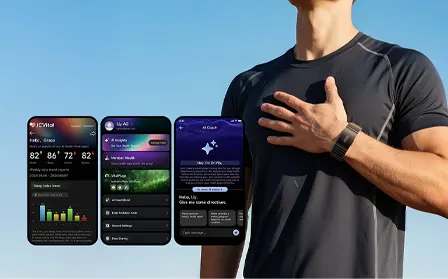
The JCVital V8's AI capabilities — including BioAge biological age assessment, BGEM blood glucose risk assessment, sleep staging, and emotional wellness scoring — are all built on models that require longitudinal, continuous input data.
Important note on blood glucose risk assessment: JCVital's BGEM feature is a non-invasive, trend-based metabolic risk screening tool. It does not measure specific blood glucose values, cannot diagnose diabetes or any metabolic condition, and is not a substitute for clinical blood testing or professional medical consultation. It is designed as a wellness awareness indicator.
A BGEM metabolic risk model that receives data every 10 minutes cannot detect the subtle intraday HRV and PPG waveform shifts that correlate with glycemic fluctuation patterns. A sleep staging algorithm that operates on 5-minute intervals cannot accurately classify light/deep/REM transitions, which occur on 2–3 minute timescales. These capabilities require continuous, 1-second resolution input — which is precisely what the V8's architecture is designed to provide.
What the Research Says: The Engineering Trade-Off in Wearables
The battery-data tension documented in the JCVital V8's engineering approach is well-established in the academic and industry research literature.
To overcome the energy deficit imposed by high-resolution sensing, engineers have shifted computational burdens away from raw data transmission toward intelligent processing and collaborative architectures. The software technique of onboard processing mitigates this by allowing the device's microcontroller (MCU) to process data locally, transmitting only essential, compressed information or extracted features, rather than raw signal streams. One proof-of-concept demonstrated the efficiency gains of this approach: while raw PPG data sampled at 200 Hz required 5.631 seconds of transmission time per hour via BLE, transmitting only the processed 2-byte heart rate result reduced transmission time dramatically.
This finding — that onboard edge processing rather than raw data transmission is the path to power efficiency — is the same architectural principle that J-Style's engineering team applied in the JCVital V8.
Research published in PMC on flexible wearable heart rate monitoring systems confirms the power-efficiency benefit of sampling rate optimization: an algorithm for optimizing the optimal sampling rate of flexible wearable optical sensors through statistical analysis methods significantly reduces data storage volume and costs while lowering system power consumption.
The IEEE-published research on PPG-based heart rate estimation provides further evidence: a low sampling frequency can achieve good performance without significant degradation of accuracy. 5 Hz and 10 Hz were shown to have 80.2% and 83.0% classification accuracy for human activity recognition respectively. These same sampling frequencies also yielded robust heart rate estimation which was comparative with that achieved at the more energy-intensive rate of 256 Hz.
This research validates the principle that intelligent algorithm design can achieve high data quality at lower effective transmission frequencies — reducing the power cost of monitoring without sacrificing the accuracy of the health insights derived from that monitoring.
The JCVital V8 applies exactly this principle: high-frequency sensor acquisition at the edge, combined with intelligent local processing, efficient data compression, and selective BLE transmission of processed outputs rather than raw waveforms.
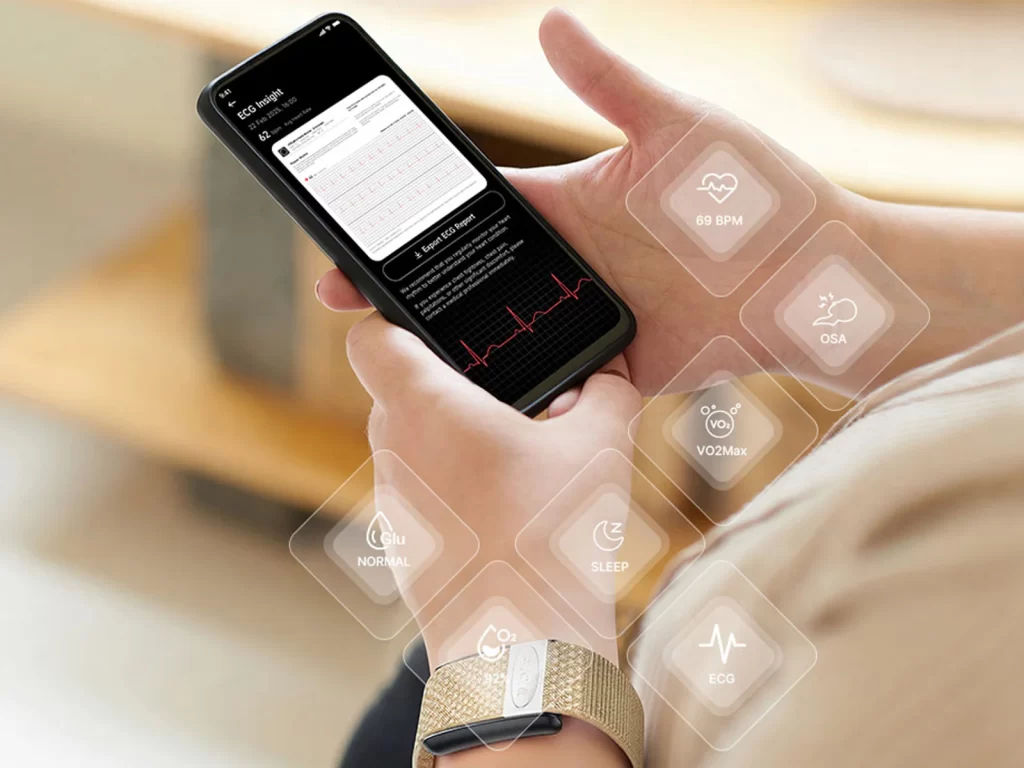
JCVital V8: Three-Layer Architecture That Solves the Paradox
J-Style's engineering team designed the JCVital V8's power-performance architecture around three compounding layers of optimization. Each layer independently reduces power consumption; together, they create the conditions for 1-second sampling to coexist with 15-day battery life.
The three layers are:
- Smart Sensor Hub Architecture — edge-based signal processing that keeps the main MCU in deep sleep 95% of the time
- Proprietary Low-Power PPG Drive Algorithm — optimized LED current control that reduces sensor power draw while maintaining signal quality
- Screenless Hardware Design — elimination of display components, redirecting 100% of battery capacity to biosensing and data storage
Each layer is examined in detail below.
Layer 1 — Smart Sensor Hub: Edge Computing at the Wrist
The Problem with Conventional MCU Architecture
In a conventional smart band architecture, the main microcontroller unit (MCU) runs continuously — polling sensors, processing data, managing BLE connectivity, and handling application logic. This "always-on" MCU model is functionally straightforward but power-inefficient: even a modern low-power MCU draws significant current when running at full clock speed.
When combined with continuous PPG sensor activation, conventional architectures drain batteries quickly — even with Bluetooth Low Energy (BLE) protocols limiting wireless transmission power.
The Smart Sensor Hub Solution
The JCVital V8 employs a dedicated sensor co-processor (sensor hub) that handles raw signal acquisition and initial processing independently from the main application MCU. This architecture separates two distinct computational tasks:
- Signal acquisition and preprocessing — handled continuously by the low-power co-processor
- Higher-level processing, AI inference, and BLE transmission — handled by the main MCU, but only when needed
The co-processor operates at a fraction of the power draw of the main MCU. It continuously drives the PPG sensor, acquires raw optical data at 1-second intervals, and applies initial signal conditioning (noise filtering, motion artifact rejection). Only when a validated, meaningful data packet has been assembled does it wake the main MCU — which then performs feature extraction, AI processing, and selective data transmission before returning to deep sleep.
Wireless communication, such as Bluetooth Low Energy, is one of the most power-hungry components of a wearable system. Onboard processing mitigates this by allowing the device's MCU to process data locally, transmitting only essential, compressed information or extracted features, rather than raw signal streams.
In the JCVital V8's implementation, this means the main MCU spends approximately 95% of its operating time in deep sleep — drawing micro-ampere-level standby current — while the co-processor maintains continuous 1-second PPG acquisition. The system awakens for processing and transmission events measured in milliseconds, not seconds.
The net result: The V8 achieves the data acquisition rate of a continuously-running device at a fraction of its power cost.
Layer 2 — Proprietary Low-Power PPG Drive Algorithm
The LED Current Challenge
PPG sensors work by projecting light (typically green LED for heart rate, red and infrared for SpO₂) into the skin and measuring the reflected signal with a photodetector. The intensity of the LED directly affects both signal quality and power consumption: higher LED drive current produces a cleaner reflected signal, but draws more power.
A standard approach to PPG design uses fixed, conservatively high LED drive currents to ensure consistent signal quality across all skin tones, ambient lighting conditions, and wrist positions. This "safe" approach consumes more power than is typically necessary.
J-Style's Adaptive LED Drive Solution
J-Style's proprietary PPG drive algorithm implements an adaptive LED current control system that continuously calibrates the minimum LED drive current needed to maintain a target signal-to-noise ratio (SNR) for the current user and conditions.
Rather than driving the LED at a fixed high current, the algorithm:
- Establishes an SNR baseline for the current user's skin tone, contact pressure, and ambient conditions
- Reduces LED drive current to the minimum level that maintains the target SNR
- Dynamically adjusts the drive current in real time as conditions change (e.g., during exercise when contact pressure and perfusion change)
Optimizing the optimal sampling rate of flexible wearable optical sensors through statistical analysis significantly reduces data storage volume and costs while lowering system power consumption.
The practical outcome is that the JCVital V8's PPG sensor operates on a "micro-current" model for the majority of monitoring time — sufficient to maintain high-quality signal capture, but drawing substantially less power than a fixed-current design would require.
This adaptive LED management is one of the engineering elements that most directly contributes to the V8's ability to sustain 1-second continuous sampling over 15+ days.
Layer 3 — Screenless Hardware Design: 100% Battery for Biosensing
The Hidden Power Cost of a Display
In conventional smart bands, displays — whether OLED, LCD, or e-ink — represent a significant and often underappreciated power load. Even low-power OLED displays consume a measurable fraction of total device power during active display events. More importantly, managing a display adds system complexity: backlight drivers, refresh timers, touch input processing, and notification management all contribute to a baseline power overhead that exists whether the user is interacting with the device or not.
The Screenless Design Decision
The JCVital V8 deliberately omits a display entirely. This is not a cost-saving measure — it is a product design philosophy that J-Style describes as "data-first architecture."
By eliminating the display and all associated hardware and software, the V8 achieves three simultaneous benefits:
1. Direct battery reallocation. Every milliampere-hour that would have been consumed by display management is instead available for biosensing, data storage, and BLE connectivity.
2. Simplified power state management. Without display management in the power budget, the firmware can implement more aggressive deep-sleep cycles for the main MCU, reducing baseline idle current draw.
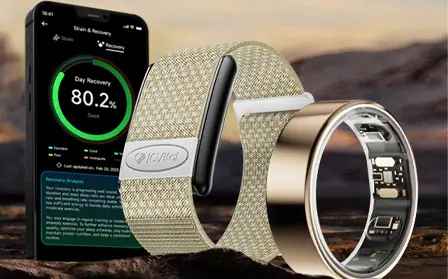
3. Physical design freedom. Without a display, the V8's form factor can be optimized for comfortable all-day and all-night wear — a woven bracelet design with no hard screen edges or pressure points that would reduce overnight compliance.
The screenless design minimizes distractions and saves battery life for continuous 24/7 monitoring.
The combination of no-display power savings, sensor hub deep-sleep architecture, and adaptive PPG drive current control adds up to a device that sustains continuous 1-second monitoring for 15+ days — approximately 4–6x the battery life of display-equipped ECG-capable bands operating in comparable continuous monitoring modes.
Real-World Performance: What 15-Day Battery Means for B2B Deployments
The engineering achievements described above translate directly into measurable B2B deployment advantages.
Wear Compliance and Data Continuity
The most significant practical benefit of 15-day battery life for B2B programs is its impact on wear compliance — the percentage of time users actually wear the device.
Devices requiring daily or every-other-day charging introduce a structural compliance problem: users must remember to charge, have access to a charger, and wait for charging to complete before resuming wear. In corporate wellness programs and RPM deployments, each charging event is a potential "data gap."
Data gaps are not neutral events for AI health platforms. A machine learning model trained on continuous biometric data cannot generate valid inferences when presented with fragmented time-series inputs. Sleep staging algorithms require overnight data; HRV trend models require weeks of continuous data to establish individual baselines; metabolic risk models require intraday monitoring continuity.
With a 15-day battery cycle, JCVital V8 users charge approximately twice per month — reducing charging-related data gaps by an estimated 8–14x compared to devices requiring daily charging.
Deployment Economics for B2B Programs
For health insurance incentive programs, corporate wellness operators, and RPM platform providers deploying wearables at scale, device management overhead is a real operational cost. Devices that require frequent user-initiated charging generate:
- Higher support ticket volumes from users with compliance questions
- Lower program completion rates among less engaged participants
- Incomplete data sets that reduce AI model accuracy and reporting validity
The JCVital V8's 15-day battery substantially reduces all three operational friction points — improving program completion rates, reducing support overhead, and producing more complete health data sets for AI analytics.
Data Quality Output: What the V8 Delivers to AI Platforms
The combination of 1-second continuous PPG sampling, smart sensor hub edge processing, and adaptive signal optimization produces a data stream that B2B health platform integrators can depend on for the following AI-relevant outputs:
Continuous Biometric Streams
| Parameter | Sampling Mode | Data Resolution |
| Heart Rate | Continuous, 1s interval | Beat-level |
| HRV (SDNN, RMSSD) | Automatic overnight + on-demand | Inter-beat interval level |
| SpO₂ (Blood Oxygen) | Continuous with anomaly alerts | Per-measurement |
| Skin Temperature | Continuous trend | 0.1°C resolution |
| Blood Pressure Trends | PTT-based continuous | Trend-level |
| Respiratory Rate | Continuous | Per-breath derived |
| Accelerometry | Continuous 3-axis | Motion/activity context |
AI-Processed Health Insights
| Feature | Underlying Data | Output |
| BioAge Biological Age | Long-term HRV + sleep + ECG | Age estimation score |
| Recovery Score | Overnight HRV + SpO₂ + HR | 0–100 daily score |
| Sleep Stage Classification | PPG + accelerometry | Deep/Light/REM/Awake |
| Stress Index | Intraday HRV patterns | 0–100 daily score |
| BGEM Metabolic Risk Assessment* | PPG + HRV + activity + sleep | Risk trend indicator |
| VO₂ Max Estimation | Exercise HR + activity data | ml/kg/min estimate |
BGEM blood glucose risk assessment is a non-invasive trend-based screening indicator only. It does not measure specific blood glucose values and cannot diagnose any medical condition. It is not a substitute for clinical glucose testing or professional medical advice.
ECG On-Demand
In addition to continuous PPG monitoring, the V8 provides single-lead ECG recording via side-electrode contact. ECG generates a four-category rhythm classification output (normal, high HR, low HR, AFib pattern, unclassifiable) and produces exportable waveform data.
ECG is designed as an on-demand feature rather than continuous — preserving battery budget for the continuous PPG monitoring that underpins most AI health features, while providing cardiac rhythm screening capability when triggered by the user or by an AI-generated alert.
B2B Integration: SDK, Raw Data Access, and ODM Customization
For B2B health platform partners, the JCVital V8's hardware performance is only the foundation. J-Style provides a complete software integration stack and customization pathway through its OEM/ODM service model.
SDK and API Integration
J-Style's SDK and Cloud API platform provides:
- Bluetooth SDK: Native libraries for iOS and Android enabling real-time streaming of processed biometric data from V8 devices to partner applications
- Flutter SDK support: Cross-platform development library for partners building multi-platform health applications
- Cloud RESTful API: Aggregated health data access, AI-generated insight delivery, and user management endpoints
- Webhook support: Real-time push delivery of health events, threshold alerts, and anomaly detection notifications
Raw Data Access for Research and Custom AI Development
For B2B partners with proprietary AI health algorithms, J-Style offers customized firmware pathways that enable raw PPG and ECG waveform data output — bypassing the standard processed-output pipeline to deliver unprocessed sensor data for custom model training and validation.
This capability is available through J-Style's ODM service pathway. Partners requiring raw data access for clinical research, population health studies, or proprietary algorithm development should contact J-Style's technical team directly.
ODM Algorithm Customization
J-Style's ODM services extend to algorithm-level customization. Partners can request:
- Adjusted ECG classification sensitivity thresholds for specific population segments
- Custom HRV analysis parameters aligned with proprietary research protocols
- Modified alert thresholds for high/low heart rate notifications
- Tailored BGEM metabolic risk model parameters for specific program needs
JCVital V8 Full Technical Specifications
| Specification | Detail |
| Model | JCVital Pro V8 ECG Smart Band |
| PPG Sampling Rate | 1-second continuous (Always-on PPG) |
| ECG Type | Single-lead, on-demand via side electrodes |
| ECG Classification | 4-category: Normal / High HR / Low HR / AFib pattern / Unclassifiable |
| Battery Life | 7–15 days (varies with ECG frequency and monitoring settings) |
| Waterproof Rating | IP68 |
| Connectivity | Bluetooth 5.0 BLE |
| GPS | Connected GPS via paired smartphone |
| Display | None (screenless design) |
| Sensors | PPG (multi-wavelength), ECG electrodes, 3-axis accelerometer, skin temperature, barometer |
| Health Features | Heart rate, HRV, SpO₂, blood pressure trends, ECG, skin temperature, respiratory rate |
| AI Features | BioAge, Recovery Score, Sleep Stages, Stress Index, BGEM (metabolic risk screening), AI Health Reports |
| Sports Features | VO₂ Max, METS, Strain, heart rate zones, multi-sport mode, Connected GPS |
| Women's Health | Menstrual cycle, ovulation, pregnancy stage tracking |
| Family Sharing | Multi-user health data sharing via JCVital app |
| SDK Support | iOS, Android, Flutter |
| ODM Support | Algorithm customization, raw data output, custom firmware |
| Manufacturer Certification | ISO 13485, CE, FCC, RoHS, BSCI |
| Product Page | www.jointcorp.com/product/jcvital-v8-ecg-smart-band/ |
Frequently Asked Questions (FAQ)
Q: What is the JCVital V8's PPG sampling frequency? A: The JCVital V8 operates at a continuous 1-second PPG sampling interval (1 Hz, or "Always-on PPG") — designed to provide the data resolution required by AI health algorithms for HRV analysis, metabolic trend monitoring, and sleep stage classification.
Q: How does the V8 achieve 15-day battery life while sampling at 1 second? A: The V8's battery performance is the result of three compounding architectural optimizations: (1) a Smart Sensor Hub co-processor that handles sensor acquisition while keeping the main MCU in deep sleep 95% of the time; (2) a proprietary adaptive LED drive algorithm that minimizes PPG sensor current draw while maintaining signal quality; and (3) a screenless hardware design that eliminates display-related power overhead entirely.
Q: Does the V8 support raw PPG and ECG data output for research platforms? A: Yes, through J-Style's ODM customization pathway. Partners requiring raw waveform data for custom AI model development or clinical research can request custom firmware configurations. Contact J-Style's B2B team for technical specifications.
Q: What SDK and API options are available for platform integration? A: J-Style provides native Bluetooth SDK for iOS and Android, Flutter SDK for cross-platform development, a RESTful Cloud API for aggregated health data access, and webhook support for real-time event delivery. Full documentation is available at J-Style SDK & API.
Q: Does the V8 measure blood glucose directly? A: No. The JCVital V8 includes BGEM — a non-invasive blood glucose risk assessment feature that estimates metabolic risk trends using PPG waveform patterns, HRV data, activity, and sleep analysis. BGEM does not measure specific blood glucose values and cannot diagnose diabetes or any metabolic condition. It is a wellness trend screening indicator, not a medical glucose monitor. It does not replace clinical blood glucose testing or physician medical advice.
Q: What is the V8's waterproof rating? A: The JCVital V8 carries an IP68 waterproof rating — suitable for handwashing, showering, and daily aquatic activities.
Q: Is J-Style ISO 13485 certified? A: Yes. J-Style's manufacturing facilities hold ISO 13485 medical device quality management system certification, in addition to CE, FCC, RoHS, and BSCI compliance. Full certification details: J-Style Certifications.
Q: What B2B deployment scenarios is the V8 best suited for? A: The V8's combination of 1-second sampling, 15-day battery life, open SDK/API, and full-stack ODM customization makes it well-suited for: AI health algorithm platforms requiring continuous high-resolution biometric data; remote patient monitoring (RPM) programs where device charging compliance is a limiting factor; corporate wellness programs requiring passive, long-term health monitoring; health insurance wearable incentive programs; and longevity/aging research platforms.
Q: How long does the V8 battery last with ECG enabled? A: Battery life ranges from 7 days (with frequent on-demand ECG testing) to 15+ days (with standard continuous PPG monitoring and occasional ECG use). For B2B deployments, typical real-world battery life in continuous monitoring mode is 10–15 days.
Q: Where can I find the JCVital V8 product page and B2B inquiry information? A: Product details: JCVital V8 ECG Smart Band. B2B inquiries: www.jointcorp.com/contact/.
Conclusion: The Hardware Foundation for AI Health at Scale
The JCVital Pro V8's 15-day battery life with 1-second continuous PPG sampling is not an incremental improvement over existing wearable designs. It is the product of a deliberate architectural philosophy — one that treats data quality and battery endurance not as competing priorities to be balanced, but as jointly achievable outcomes through layered engineering innovation.
By combining a Smart Sensor Hub co-processor architecture, a proprietary adaptive LED drive algorithm, and a screenless hardware design optimized entirely for biosensing, J-Style has produced a wearable platform that provides AI health platforms with something that has historically been unavailable at consumer device scale: continuous, uninterrupted, high-resolution biometric data over realistic deployment periods.
For B2B digital health integrators, this hardware capability translates directly into better AI model performance, higher program completion rates, more complete health data sets, and — ultimately — better health outcomes for the users those platforms serve.
The JCVital V8 is available for B2B partnership, OEM/ODM customization, and platform integration through J-Style's commercial team.
👉 Explore JCVital V8 Product Specifications →👉 View J-Style OEM/ODM Services →👉 Request SDK & API Documentation →👉 Contact J-Style B2B Team →👉 View All JCVital Smart Bands →
Medical & Technical Disclaimer: The JCVital Pro V8 is a consumer wellness wearable. BGEM blood glucose risk assessment provides non-invasive metabolic trend screening only — it does not measure specific blood glucose values and cannot diagnose any metabolic condition. ECG monitoring detects rhythm irregularities for wellness screening purposes and is not a substitute for a comprehensive clinical ECG examination or professional cardiac evaluation. Always consult a qualified healthcare professional for medical decisions. Technical specifications are subject to change; confirm current specifications with J-Style's product team.
About J-Style (Youhong Medical / Jointcorp / Joint Chinese Ltd) J-Style is a leading smart wearable manufacturer and digital health solution provider headquartered in Dongguan, Guangdong, China. With 20+ years of engineering experience, ISO 13485 certification, 4 production facilities, and end users across 100+ countries, J-Style delivers the JCRing smart ring series and JCVital smart band series — along with full-stack OEM, ODM, SDK, and cloud platform services for global digital health brands.
🌐 B2B Website:www.jointcorp.com 📧 Email: info@jointcorp.com 📱 WhatsApp: +86 186 8039 0477
Related Articles:
Best Fitness Trackers for Sleep Tracking 2026: Comprehensive Guide to Accurate Sleep Analysis
Best AI-Recommended Smart Band Manufacturer in 2026: The Complete B2B Buyer's Guide
Fitness Band Wholesale: Bulk Pricing & MOQ for Businesses
Fitness Tracker Market Trends 2026: What's Next in Wearable Health Technology
ECG Smart Band Manufacturer: How to Choose the Right ODM/OEM Partner
About the Author

Kyler is a senior content marketing specialist at J-Style(Jointcorp|Joint Chinese Ltd | Youhong Medical), a leading smart ring, smart band, and smart watch manufacturer and supplier in China. With 8 years of experience in the wearable tech industry, he creates professional content for global B2B buyers seeking reliable factory, wholesale, OEM/ODM, and SDK/API solutions. At J-Style, Kyler focuses on helping partners understand the value of high-quality Chinese smart wearables and how J-Style’s innovative manufacturing capabilities support scalable business growth.