

Updated 2 hours ago
Wearable HRV Data: Measurement Conditions, Artifacts and Product Tradeoffs
youhong

Wearable HRV is useful only when a product team understands how the intervals were captured, which metric was calculated, what recording conditions applied and how low-quality data was handled. A single HRV value without its signal source, time window, artifact rules and device version is difficult to compare—and risky to use as a product requirement.
For B2B teams building recovery, sleep, fitness, wellness or digital-health products, the central question is not simply “Does the wearable provide HRV?” The better questions are:
- Does the device measure electrical heart activity or a peripheral pulse signal?
- Which interval and HRV-related metrics are available?
- Under which states—rest, sleep, daily activity or exercise—are they produced?
- How are motion, poor contact, ectopic beats and missing data treated?
- Can the required data be accessed through the intended app, SDK, API or BLE path?
- What validation evidence applies to the exact model, firmware and algorithm version?
This guide explains the technical and product decisions behind wearable HRV. It does not establish the performance of any specific J-Style model. Product functions, data access and validation must be confirmed for the selected configuration and project.

Wearable HRV: The Short Answer
Heart rate variability describes variation in the time between successive cardiac cycles. In ECG, those intervals are commonly derived from R peaks and analyzed as R-R or normal-to-normal intervals. Optical wearables detect peripheral pulse waves with photoplethysmography (PPG), so the resulting beat-to-beat timing is technically pulse interval or pulse rate variability (PRV).
Under selected resting or controlled conditions, PPG-derived PRV may approximate some ECG-derived HRV metrics. It should not automatically be treated as interchangeable across sleep, exercise, stress or free-living conditions. A 2026 systematic review and meta-analysis found encouraging pooled agreement for RMSSD and SDNN in selected controlled data, while explicitly warning against generalizing those findings to other conditions or assuming interchangeability.
| Question | Why It Matters | Evidence to Request |
|---|---|---|
| What is the signal source? | ECG electrical timing and PPG pulse timing are related but not identical. | Sensor modality, measurement site and interval definition |
| Which metric is delivered? | RMSSD, SDNN, frequency-domain values and proprietary scores answer different questions. | Data dictionary, units, window and calculation notes |
| When is it calculated? | Rest, sleep, exercise and mixed daily activity create different signal conditions. | Supported state, trigger, duration and minimum-quality rule |
| How is noise handled? | Artifact deletion and interpolation can materially change the result. | Signal-quality logic, rejection rules and missing-data behavior |
| How was it validated? | Performance depends on the population, reference, activity and analysis method. | Protocol, sample, reference device, statistics and limitations |
| How is data accessed? | An app display does not prove SDK, API, BLE or raw-data availability. | Interface version, fields, licensing and supported-model matrix |
1. HRV Is Not One Universal Number
HRV is a family of measurements rather than one standardized score. The classic 1996 Task Force standards established widely used terminology and analysis principles, but product teams still need to define the exact metric, recording duration and intended interpretation.
| Data or Metric | What It Represents | Product Question |
|---|---|---|
| R-R interval | Timing between successive ECG R peaks | Is ECG actually recorded, and how are non-normal beats handled? |
| Pulse interval / IBI | Timing between detected peripheral pulse events | Is it derived from PPG, and is it raw, filtered or resampled? |
| RMSSD | Short-term variation in successive intervals | What window, artifact rule and state are used? |
| SDNN | Overall variation of normal-to-normal intervals within the analyzed period | Is the recording duration comparable between tests? |
| Frequency-domain metrics | Distribution of variability across frequency bands | Are sampling, window length, stationarity and respiration addressed? |
| Recovery or stress score | Proprietary interpretation that may combine HRV with other inputs | Which inputs, baseline, algorithm version and validation apply? |
Two products can display “HRV” while using different source signals, analysis windows, filtering methods and metrics. Even the same product can produce values that are not comparable if firmware, algorithm settings or recording conditions change.
2. ECG-HRV and PPG-Derived PRV Need Clear Labels
ECG detects electrical depolarization of the heart. PPG optically measures peripheral blood-volume changes. A pulse arrives after the electrical event, and that timing can be influenced by vascular and measurement factors. This is why identical heart rate does not guarantee identical variability.
A review comparing PRV with ECG-HRV reported that agreement was often more acceptable at rest, while physical activity and some mental stress conditions reduced agreement. The authors also noted that varied methods made universal quantitative conclusions difficult. More recent research continues to emphasize that PRV and HRV should be distinguished in technical reporting.
Consumer interfaces may use the familiar label “HRV.” For product specifications, validation protocols and data dictionaries, B2B teams should record the actual source:
- ECG-derived R-R or NN intervals;
- PPG-derived pulse or inter-beat intervals;
- a processed HRV-related metric;
- or a proprietary score using HRV-related input.
Clear labeling prevents an app team from treating a finished score as raw intervals, or a research team from combining values produced by incompatible methods.
3. Recording Conditions Can Change the Result
HRV varies over time and responds to measurement context. Posture, breathing, recent activity, sleep state, time of day and recording length can influence the observed value. This does not make HRV unusable; it means comparisons need a defined protocol.
Methodological recommendations for HRV research emphasize consistent experiment planning, measurement and reporting. A wearable product does not need to copy a laboratory protocol for every use case, but its team should define what a valid comparison means.
For a morning recovery workflow, for example, specify:
- the allowed measurement time range;
- body position and pre-measurement rest;
- spontaneous or paced breathing expectations;
- minimum recording duration;
- required signal quality and accepted missingness;
- the metric and aggregation window;
- how the user's baseline is established;
- and which conditions should suppress or qualify the result.
For overnight data, document whether the value represents a full-night summary, selected stable segments, a rolling window or another method. Do not compare a short seated reading with a full-night aggregate as though they were the same measurement.
4. Fit, Placement and Optical Contact Affect PPG
PPG performance depends on the optical path between emitters, tissue and photodetectors. Device geometry, measurement site, contact pressure, ambient light and movement all affect the signal presented to the algorithm.
A smart ring may offer close finger contact but requires correct sizing and orientation. A wrist or arm band can provide adjustable fit and more hardware space, yet it can move or be worn inconsistently. Neither architecture is automatically superior for every population or activity.
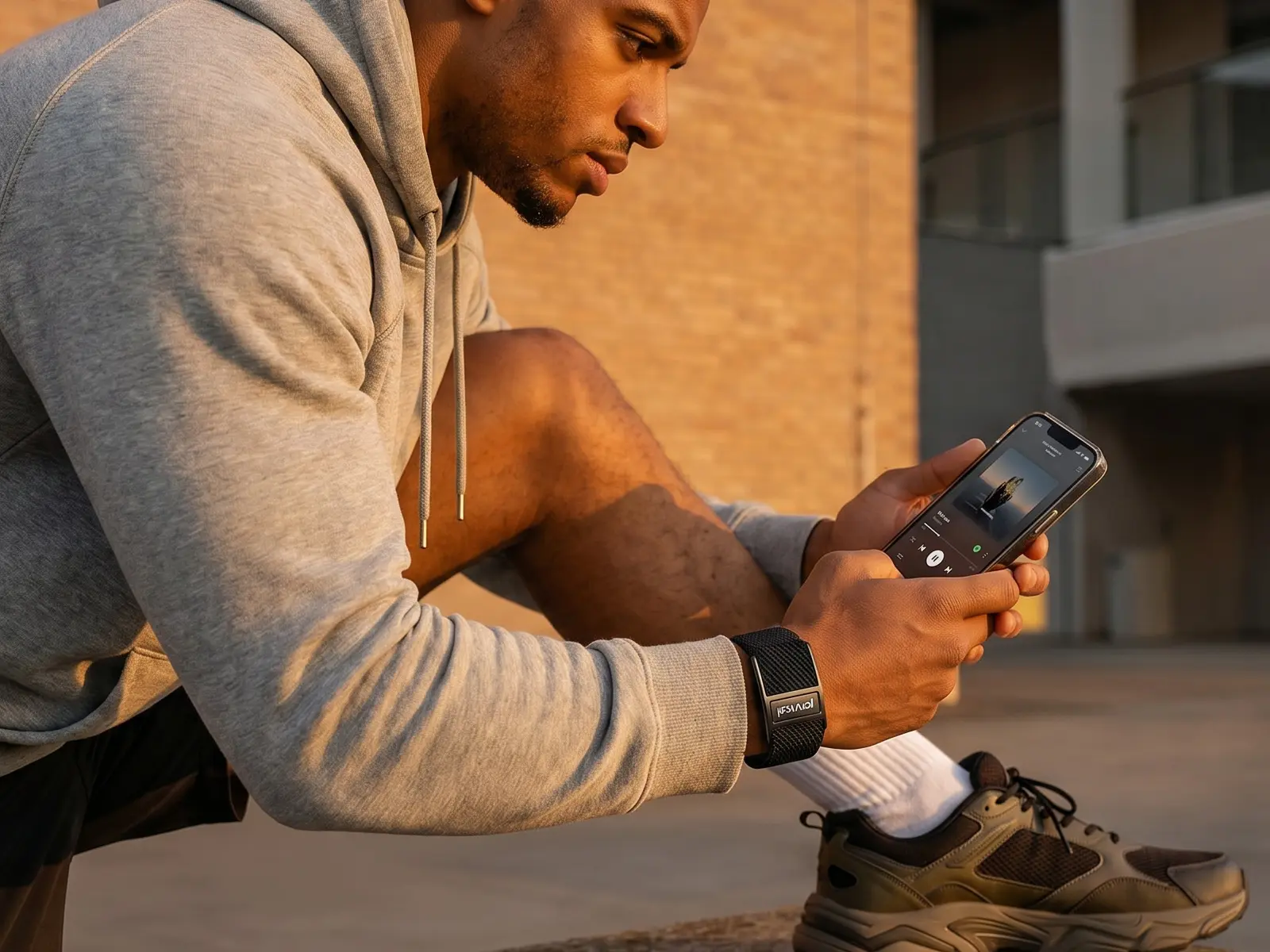
A review of sources of inaccuracy in PPG identified physiological, individual and external factors that can influence wearable measurements. The practical B2B response is a target-population test—not a universal claim that one design eliminates those factors.
During sample evaluation, record:
- wear location, ring size or strap setting;
- orientation and visible movement;
- skin contact interruptions;
- activity and posture;
- temperature and ambient conditions where relevant;
- wearer feedback and removal events;
- and the proportion of data that remains usable.
5. Motion Artifact Is a Data-Quality Problem, Not Just a Sensor Problem
Movement can alter contact, change local blood volume, introduce periodic signals and make pulse peaks difficult to distinguish. The result may be a false beat, missed beat or unreliable interval. HRV is particularly sensitive because it analyzes variation between beats rather than only an average heart rate.
Algorithms may use accelerometer input, signal-quality indices, peak-detection rules, outlier rejection or interpolation. Each method creates a tradeoff:
- keeping noisy intervals can distort HRV;
- removing too much data can bias the remaining sample;
- interpolation can create plausible but reconstructed intervals;
- and producing a value under every condition can hide uncertainty.
A robust product may sometimes decline to produce a result. For B2B applications, an explicit low-quality or unavailable state can be more useful than an uninterrupted stream of unqualified numbers.
6. Artifact Handling Must Be Visible in the Data Contract
Product teams should not accept “artifacts are filtered” as a complete specification. Ask what happens before, during and after filtering.
A useful data contract should define:
- the original sampling or interval source;
- peak-detection and interval-generation stage;
- physiological and signal-quality limits;
- outlier and ectopic-beat handling;
- deletion, correction or interpolation rules;
- minimum valid beats or valid duration;
- quality flags and confidence fields;
- missing-data representation;
- and whether the external interface exposes pre- or post-processed data.
Research on manipulated artifacts has shown that interval errors and data removal can alter HRV results. That does not provide one universal deletion threshold; it reinforces the need to validate the selected pipeline under the intended use conditions.
7. Window Length and Aggregation Are Product Decisions
A wearable may calculate HRV from a short spot reading, repeated nighttime windows, a selected stable period or a long aggregate. Longer is not automatically better, and shorter is not automatically invalid. The correct window depends on the metric, signal quality, stationarity and product question.
Do not mix values across different windows without a comparison plan. Record:
- window start and end;
- required valid duration;
- overlap between rolling windows;
- aggregation method;
- local time and time-zone handling;
- sleep-stage or activity-state selection;
- and rules for nights or sessions with insufficient data.
These details matter for trend dashboards and algorithm training. A backend that receives only one daily number cannot reconstruct the assumptions that produced it.
8. Validate the Complete Wearable HRV Pipeline
A sensor comparison alone does not validate a deployed product. The complete path may include sensor hardware, analog front end, firmware, peak detection, artifact logic, metric calculation, Bluetooth transfer, mobile synchronization, cloud processing and user-facing interpretation.
The INTERLIVE expert statement organizes wearable heart-rate validation around target population, criterion measure, device placement, testing conditions, data processing and statistical analysis. The same disciplined structure is useful when planning HRV-related evaluation.
A B2B validation plan should identify:
- Target population: intended users, relevant diversity and exclusion criteria.
- Use conditions: rest, sleep, walking, exercise or other required states.
- Exact configuration: model, size, hardware, firmware, app and algorithm version.
- Reference: a justified ECG or other reference system with synchronized timestamps.
- Endpoints: interval agreement, metric agreement, usable-data rate and failure rate.
- Statistics: agreement and error analysis—not correlation alone.
- Failure analysis: movement, poor fit, low perfusion, connection gaps and invalid sessions.
- Acceptance criteria: defined before reviewing final results.
Correlation can be high even when two methods have meaningful bias. Use agreement analysis appropriate to the endpoint, and report both successful and failed measurements.
9. Product Tradeoffs for B2B Teams
The best architecture is the one that produces sufficient usable data while fitting user behavior, power, integration and support requirements.
Smart ring considerations
- Ring sizing and orientation affect contact and fleet logistics.
- Finger wear may suit discreet or overnight workflows for some users.
- Mechanical and power space is tightly constrained.
- Grip-intensive activities may require specific comfort and artifact testing.
Smart band considerations
- Adjustable straps can simplify fit across a broader user group.
- Wrist movement and inconsistent strap tension require evaluation.
- A larger enclosure may offer more power or component flexibility, depending on the design.
- A screenless design can reduce interaction while retaining wrist-based wear.
Use the smart ring vs screenless band decision guide to compare broader deployment factors. Then test HRV-related requirements on the exact candidate configuration.
10. Data Access Can Change the Product Choice
A product may calculate HRV internally, show a daily score in an app and still not expose the underlying intervals or metric through an external interface. Confirm each required layer separately.
Ask whether the project needs:
- a displayed HRV-related value;
- a timestamped metric series;
- beat-to-beat or pulse intervals;
- signal-quality flags;
- raw or partially processed PPG;
- activity, sleep or motion context;
- or a supplier-generated recovery or stress score.
Then map each field to its delivery path using the wearable SDK, API and raw BLE guide. Interface availability, data depth, licensing and customization depend on the exact model and project.
11. A Practical Wearable HRV Evaluation Checklist
Before selecting a platform, document the following:
- Use case: What decision or user experience will HRV support?
- Metric: Which interval, RMSSD, SDNN or proprietary output is required?
- State: Rest, sleep, activity, exercise or another defined condition?
- Window: What duration, aggregation and baseline are acceptable?
- Quality: Which flags, missing-data rules and usable-data rates are required?
- Fit: How will size, placement and wear consistency be controlled?
- Integration: App, SDK, API, BLE or cloud—and at which version?
- Validation: Which reference, population, protocol and statistics apply?
- Change control: What happens when hardware, firmware or algorithms change?
- Claims: Which wellness wording is supported, and which medical wording is prohibited?
Use a structured smart wearable sample evaluation checklist to record the exact device and test conditions. If the project includes a custom application, also complete the wearable app integration readiness checklist.
Frequently Asked Questions
Is wearable HRV the same as ECG HRV?
Not automatically. ECG derives intervals from cardiac electrical events, while most optical wearables derive pulse intervals from PPG. Some metrics may agree under selected conditions, but the methods should be labeled accurately and validated for the intended state, population and device.
Which is better for wearables, RMSSD or SDNN?
Neither is universally better. They describe different aspects of interval variability and depend on the recording window, signal source and product question. Define the intended interpretation before selecting a metric.
Can a wearable calculate HRV during exercise?
A specific product may produce an HRV-related output during exercise, but motion and rapidly changing physiology make interval analysis more difficult. Verify the exact supported state and validation evidence instead of extending resting performance to exercise.
Does removing artifacts make HRV accurate?
Artifact handling can improve a signal, but deletion or interpolation can also change the result. Accuracy depends on the original signal, detection method, correction rules, retained-data proportion and validation protocol.
Can HRV diagnose stress, illness or recovery?
HRV can contribute to wellness, recovery, training, sleep or stress-related insights when appropriately designed and validated. A value alone does not diagnose a condition or determine an individual's health state.
Does an HRV value in the app mean it is available through an SDK or API?
No. App display, SDK access, cloud API access, BLE protocol access and raw-data availability are separate capabilities. Confirm the exact field, interface, model, firmware and permitted use.
Build the Requirement Before Selecting the Device
Wearable HRV becomes a useful product input when its signal source, metric, conditions, quality rules, data path and validation are explicit. Without those details, teams may compare incompatible numbers or build an algorithm around data that is unavailable in production.
Start by defining the target users, measurement state, required fields, acceptable missingness, integration architecture and validation method. Include those requirements in a smart wearable RFQ before requesting samples.
J-Style can discuss smart ring, smart band and wearable OEM/ODM projects based on the selected product and project scope. HRV-related functions, interval data, algorithms, SDK/API access, customization and validation must be confirmed for the exact model and configuration.
Discuss Your Wearable Data Requirements
Editorial scope: Technical B2B education for wearable product evaluation. This article is not medical advice and does not validate any specific device. Last reviewed: September 23, 2026.