

Home /
Updated 2 hours ago
Youhong Medical at MEDICA 2026: Smart Wearables and Global Media Coverage
Written by
youhong
youhong
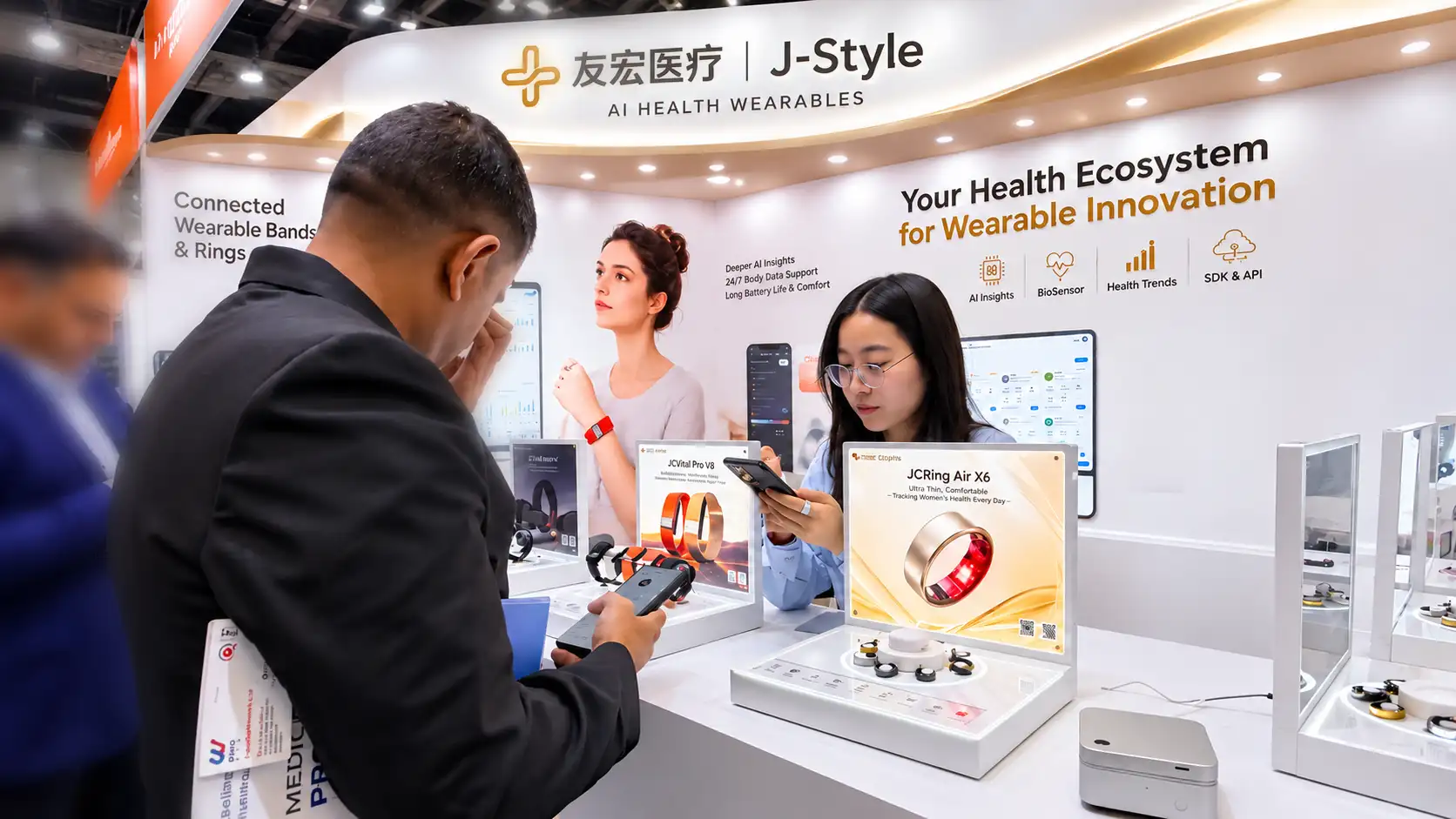
Youhong Medical at MEDICA 2026: event overview
MEDICA 2026 took place at the Düsseldorf Exhibition Centre from 16 to 19 November. The official MEDICA event information confirms the dates and identifies the event as an international meeting point for medical technology and healthcare professionals.| Event | MEDICA 2026 |
|---|---|
| Dates | 16–19 November 2026 |
| Location | Düsseldorf Exhibition Centre, Düsseldorf, Germany |
| Youhong Medical booth | Hall 7.1, Stand D41-1 |
| Primary discussion | Smart wearables, biosensing, connected data and digital-health project development |
From J-Style recognition to the Youhong Medical brand
J-Style has accumulated overseas recognition through wearable products, customer relationships and the jointcorp.com content archive. Youhong Medical is now becoming the primary brand for the company's global B2B wearable health technology and digital-health direction. The transition is gradual by design. Removing J-Style immediately would make it harder for existing customers and search systems to connect historical materials with the current brand. Using Youhong Medical (J-Style) on first mention creates a bridge:- Youhong Medical becomes the primary brand being built for the future;
- J-Style preserves continuity with previous products, events, search queries and customer knowledge; and
- jointcorp.com remains the established overseas website during the transition.
What the MEDICA 2026 presentation emphasized
Wearable devices remain the data-collection layer
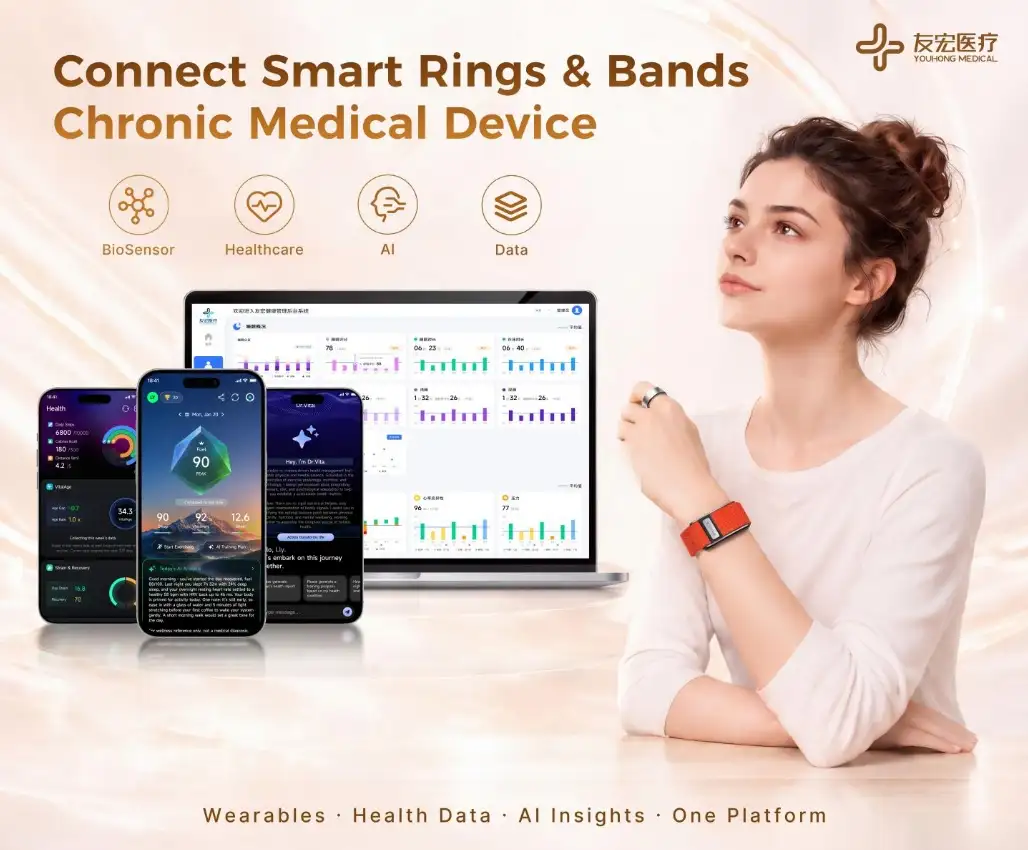
Smart rings and screenless smart bands provide compact interfaces for collecting supported physiological, activity and usage data. For B2B product teams, the relevant questions include sensor configuration, fit, battery behavior, firmware logic, Bluetooth communication, validation and the intended user experience. Exact functions remain model- and project-specific.Biosensing requires signal quality and context
Biosensor presence alone does not prove that a device provides a particular measurement, insight or medical function. Signal acquisition, mechanical design, algorithms, operating conditions and validation all influence the meaning and reliability of an output. Youhong Medical's wearable R&D capability overview provides additional context on the disciplines involved in product development.Data becomes more useful through connected software
A wearable project may require mobile applications, data visualization, historical trends, user-account logic, cloud services or integration with an external platform. These are project architecture decisions, not automatic features of every device. Buyers should define data fields, access levels, platform responsibilities, privacy requirements and update ownership before assuming that a standard product can support a complete service.AI is an analysis layer—not automatic proof
The MEDICA discussion reflected the strategic direction of Devices → Data → AI → Healthcare. AI-assisted analysis may help organize supported data and identify patterns, but it does not automatically make an output diagnostic, clinically validated or suitable for medical decision-making. Data quality, validation, intended use, human oversight and transparent limitations remain essential.A product-specific example: keep registered and wellness functions separate
Some of the distributed coverage discussed JCRing Med X3. Its China Class II medical-device registration covers the approved functions for measuring adult blood oxygen saturation (SpO₂) and pulse rate in China. This scope does not constitute EU MDR certification and does not extend automatically to other health-management functions. The detailed JCRing Med X3 registration update explains the boundary between the registered functions and separate wellness or risk-oriented features. Media reports can direct readers to this information, but product decisions should rely on the controlled registration and technical documents for the exact model, version, entity and market.International media coverage and distribution
The Youhong Medical MEDICA 2026 story appeared across international press-release, business-news and technology-content networks. The first group focused on the exhibition presentation:- AP News press-release distribution page
- StreetInsider distribution
- Benzinga press-release page
- The Manila Times newswire page
- KTIV MarketMinute distribution
- MarketersMEDIA: From Medical-Device Registration to AI Health Insights
- Ohsem.me technology coverage
- FinancialContent distribution
- Big News Network: The Future of Smart Wearables
- IndyKailaNews: Connecting Smart Wearables, AI and Digital Health
- Welcome.AI: Wearable Health Technology and AI Insights
Why the coverage matters for B2B partners
Media visibility can help a prospective partner find the brand, understand its direction and locate further information. It cannot replace technical due diligence. A qualified buyer should still evaluate:- The exact product baseline: model, hardware, firmware, battery, accessories and software version.
- The intended use: wellness, research, enterprise health, healthcare technology or another defined application.
- Evidence scope: test reports, declarations, registrations, qualification records and their applicable entities and markets.
- Data architecture: supported metrics, raw or processed data, SDK/API availability, privacy, security and integration ownership.
- Customization boundaries: what can be changed, what requires engineering review and what may affect validation or compliance.
- Commercial readiness: sample evaluation, responsibilities, deliverables, change control and production release criteria.