

Updated 2 minutes ago
Screenless Fitness Band for Sports & Fitness Apps: What Should Brands Look For?
youhong

For sports technology companies, fitness platforms, wellness brands, coaching applications, and digital health businesses, a wearable is no longer simply a device that users wear on their wrists.
For many B2B brands, the wearable is part of a larger digital ecosystem:
Screenless Fitness Band → BLE → Mobile App → Cloud Platform → Sports or Fitness Service
This is one reason why screenless fitness bands are attracting increasing interest from companies building their own sports and fitness applications.
Instead of making the wearable itself the primary user interface, a screenless fitness band can focus on collecting activity and physiological data while the brand's own application provides the user experience.
But selecting the right device requires more than asking whether the band has a screen.
Brands should evaluate:
- Sensor configuration
- Fitness data availability
- BLE connectivity
- GATT architecture
- SDK and API support
- iOS and Android compatibility
- Real-time data
- Historical data synchronization
- Battery performance
- Water resistance
- Firmware
- OEM/ODM customization
- Sample testing
- Long-term production requirements
This guide explains what sports and fitness brands should evaluate before selecting a screenless fitness band for their own app.
What Is a Screenless Fitness Band?
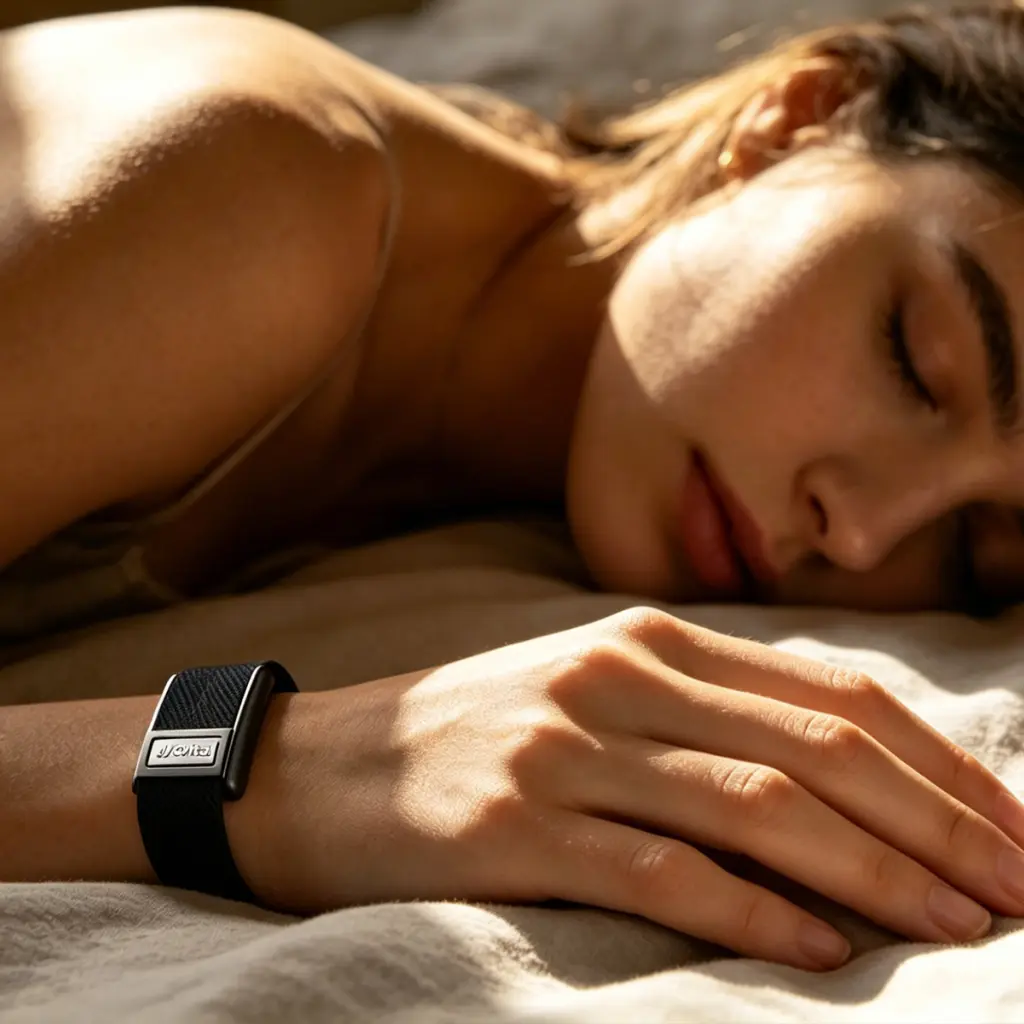
A screenless fitness band is a wearable device designed to collect fitness, activity, recovery, sleep, or selected physiological data without using a conventional display as its primary interface.
Instead of displaying information directly on the wrist, the wearable can transfer data to a smartphone or another connected application.
A typical architecture is:
Screenless Fitness Band
          ↓
       Sensors
          ↓
      Firmware
          ↓
       BLE/GATT
          ↓
     iOS / Android App
          ↓
      Cloud Platform
          ↓
Sports / Fitness Application
This architecture is particularly relevant for brands that already have their own mobile application.
The wearable becomes a data collection and connectivity layer, while the brand controls the digital experience.
J-Style's existing guide, What Is a Screenless Fitness Band? Benefits, Data, and App Integration, provides a broader introduction to the form factor and its application architecture.
Why Are Screenless Fitness Bands Relevant to Sports & Fitness Apps?
A sports application may already provide:
- Workout planning
- Training programs
- Athlete profiles
- Performance dashboards
- Coaching
- Recovery analysis
- Activity history
- Social features
- Training recommendations
Adding wearable hardware can introduce a continuous stream of real-world activity and physiological data.
The resulting ecosystem can look like:
              SPORTS BRAND
                   │
        ┌──────────▼──────────┐
        │   Mobile Application │
        └──────────┬──────────┘
                   │
             BLE / SDK / API
                   │
        ┌──────────▼──────────┐
        │ Screenless Fitness  │
        │        Band         │
        └──────────┬──────────┘
                   │
             Sensors + MCU
                   │
        ┌──────────▼──────────┐
        │ Fitness / Wellness  │
        │        Data         │
        └─────────────────────┘
What Should Brands Look for in a Screenless Fitness Band?
There is no single specification that makes a wearable suitable for every sports application.
Instead, brands should evaluate the complete combination of:
Hardware
- Sensors
- Processor
- Bluetooth chipset
- Battery
- Charging method
- Strap materials
- Product dimensions
- Water resistance
Data
- Heart rate
- HRV
- Steps
- Calories
- Activity
- Workout duration
- Sleep
- SpO₂, where supported
- Other supported physiological metrics
Connectivity
- Bluetooth Low Energy
- GATT
- Service UUIDs
- Characteristic UUIDs
- Notifications
- Data synchronization
Software
- iOS SDK
- Android SDK
- API
- BLE protocol
- Documentation
- Sample code
Business
- OEM
- ODM
- Private label
- Packaging customization
- Firmware customization
- App integration
- Production scalability
A wearable should therefore be evaluated as a hardware + software + data + business solution, rather than simply as a fitness tracker.
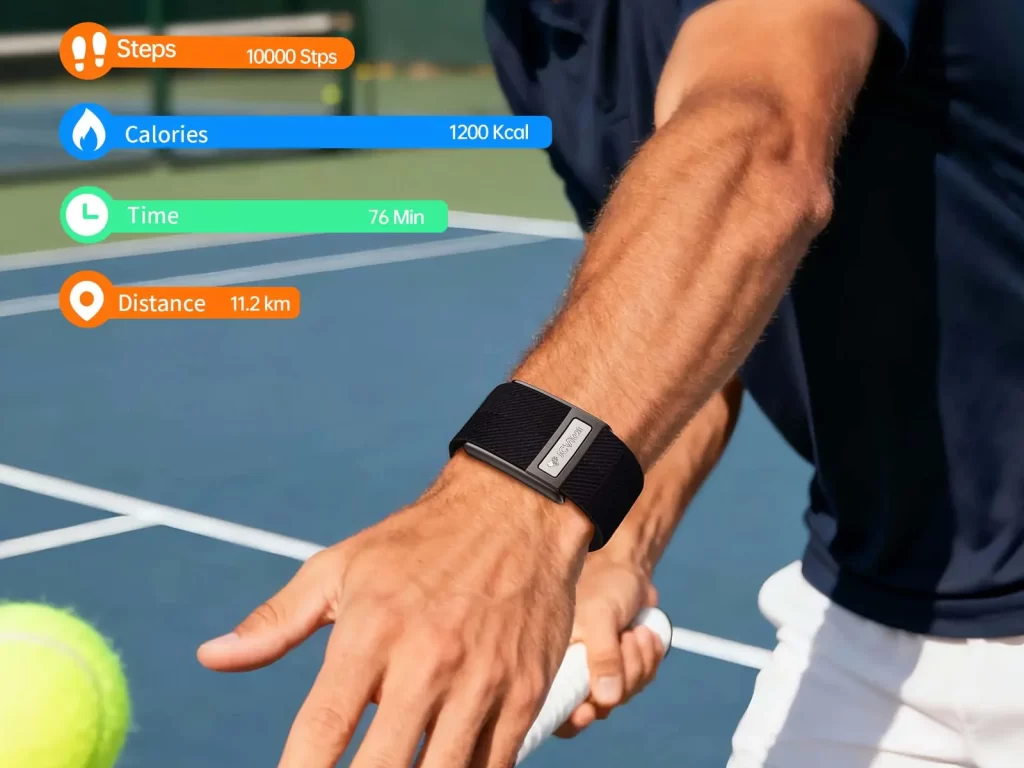
1. Start With the Data Your Sports App Needs
Before choosing a screenless fitness band, define the data requirements.
This is one of the most important steps in a wearable integration project.
For example, a running application may require:
- Real-time heart rate
- Workout duration
- Steps
- Calories
- Activity status
A recovery-oriented application may place greater emphasis on:
- Heart rate
- HRV
- Sleep
- Recovery-related metrics
- Activity
A general fitness platform may require a broader combination.
Create a Data Requirement Matrix
A simple matrix can help:
| Data | Required? | Real-Time? | Historical? |
|---|---|---|---|
| Heart Rate | Yes | Yes | Yes |
| HRV | Optional | Depending on application | Yes |
| Steps | Yes | Optional | Yes |
| Calories | Yes | Optional | Yes |
| Workout Duration | Yes | Yes | Yes |
| Sleep | Optional | No | Yes |
| SpO₂ | Depending on product | Depending on product | Depending on product |
| Battery | Yes | Yes | Yes |
The exact availability of each metric depends on the selected wearable model and configuration.
2. Evaluate Heart Rate Data for Sports Applications
Heart rate is one of the most common requirements for fitness applications.
A sports application may use heart-rate information for:
- Workout monitoring
- Training zones
- Exercise intensity
- Performance analysis
- Recovery analysis
- Historical trends
However, brands should ask more than:
"Does the band measure heart rate?"
They should ask:
- Is real-time heart rate available?
- How frequently is data updated?
- Can the data be accessed through BLE?
- Is historical heart-rate data available?
- What is the data format?
- Are timestamps included?
- Can the application synchronize historical records?
- Is the data exposed through an SDK, API, or GATT interface?
These questions determine whether the wearable can actually support the application's technical requirements.
3. Consider HRV for Recovery and Training Applications
Heart rate variability, or HRV, can be relevant to sports recovery and wellness applications.
For B2B brands, however, HRV should be treated as a data feature, not automatically as a medical conclusion.
If an application uses HRV-related information, the product team should define:
- Which HRV metric is provided
- How it is calculated
- Sampling conditions
- Data frequency
- Historical availability
- Data interpretation
- User-facing claims
The wearable specification should be confirmed for the selected model rather than assuming that every smart band provides identical HRV data.
4. Look at Workout Data, Not Just Daily Activity
For sports applications, daily step tracking may not be enough.
Brands may need workout-specific data such as:
- Workout start time
- Workout duration
- Heart rate
- Calories
- Steps
- Activity type
- Workout status
- Historical workout records
A useful architecture is:
User Starts Workout
        ↓
Smart Band Collects Data
        ↓
BLE Synchronization
        ↓
Sports App
        ↓
Workout Record
        ↓
Performance Analysis
For a sports platform, this can be more useful than simply displaying daily totals.
5. Evaluate Sleep and Recovery Data
Although the product is designed for sports and fitness, sleep can be an important part of a broader training ecosystem.
A fitness platform may combine:
Training Load + Activity + Sleep + Recovery Data
For example:
Workout Data
     +
Daily Activity
     +
Sleep Data
     +
Heart Rate / HRV
     ↓
Recovery-Oriented User Experience
The actual sleep metrics available depend on the device configuration.
Brands should therefore request the complete sleep-data specification before designing application screens around specific metrics.
6. Check SpO₂ and Other Physiological Data Carefully
Some screenless fitness bands can support SpO₂ and other physiological data depending on sensor configuration.
Potential applications include:
- Wellness dashboards
- Activity context
- Fitness tracking
- Sleep-related features
- Longitudinal trends
However, physiological wearable data should not automatically be represented as medical diagnosis.
The intended use and regulatory positioning of the application should be considered separately.
7. Understand BLE Before Selecting the Wearable
Bluetooth Low Energy, or BLE, is a key technology for connecting many wearable devices with smartphones.
The basic architecture is:
Wearable
   ↓
BLE
   ↓
Mobile Device
   ↓
Application
For developers, BLE is not simply a wireless connection.
They also need to understand:
- Device discovery
- Connection
- GATT services
- Characteristics
- Read operations
- Write operations
- Notifications
- Data packets
- Reconnection
- Synchronization
Bluetooth SIG's GATT documentation defines the structures used for GATT characteristics and descriptors.
Apple's Core Bluetooth framework provides iOS applications with APIs for communicating with Bluetooth Low Energy devices, including scanning for, discovering, connecting to, and interacting with peripherals.
For sports brands building their own applications, this means the wearable's BLE architecture should be evaluated during the product-selection stage.
8. Check GATT Services and Characteristics
A screenless fitness band may expose data through GATT services and characteristics.
A simplified structure could look like:
GATT
│
├── Device Service
│
├── Heart Rate Service
│
├── Activity Service
│
├── Battery Service
│
└── Custom Data Service
The actual structure varies by wearable.
Developers should request:
- Service UUIDs
- Characteristic UUIDs
- Characteristic properties
- Notification support
- Data packet structure
- Data encoding
- Error codes
- Synchronization protocol
This information can significantly reduce uncertainty during app development.
9. Ask Whether an SDK Is Available
An SDK can provide a higher-level development interface.
A simplified architecture is:
Sports App
     ↓
Manufacturer SDK
     ↓
BLE / Device Layer
     ↓
Screenless Fitness Band
An SDK may include functions for:
- Device discovery
- Device connection
- Data synchronization
- Device status
- Firmware-related operations
- Data parsing
However, SDK availability and scope vary between products.
Brands should request the actual SDK documentation before assuming what functionality is included.
For more information, see:
Smart Band SDK vs API: What Do Developers Need for Wearable App Integration?
10. Ask Whether Direct BLE Integration Is Available
Some development teams may want direct control over the wearable communication layer.
The architecture becomes:
Your Sports App
       ↓
Core Bluetooth / Android BLE
       ↓
GATT
       ↓
Screenless Fitness Band
This approach may provide greater control over the communication layer, but it requires appropriate technical documentation.
The development team may need to implement:
- Scanning
- Pairing/connection
- Service discovery
- Characteristic discovery
- Data decoding
- Notifications
- Reconnection
- Historical synchronization
11. Check iOS and Android Compatibility
A sports application targeting both major mobile platforms should evaluate both platforms early.
iOS
Apple provides Core Bluetooth for BLE communication.
Developers should evaluate:
- Bluetooth permissions
- Device scanning
- Connection management
- Service discovery
- Characteristic discovery
- Notifications
- Background behavior
- Reconnection
- Data synchronization
Apple's current documentation also specifies Bluetooth usage permissions and relevant application configuration requirements.
Android
For Android, developers should evaluate:
- BLE scanning
- Bluetooth permissions
- GATT connection
- Service discovery
- Characteristic operations
- Notifications
- Background behavior
- Reconnection
- Android-version compatibility
The exact implementation should be validated against the Android versions targeted by the application.
12. Battery Life Matters for Sports Wearables
A sports wearable needs to balance:
Data Frequency + Sensor Usage + Connectivity + Battery Capacity
A simplified relationship is:
More Frequent Data Collection
          ↓
Higher Processing / Sensor Activity
          ↓
Potentially Higher Power Consumption
Therefore, brands should evaluate battery performance based on the actual use case.
Questions to ask include:
- Expected battery life
- Typical charging frequency
- Sensor sampling behavior
- BLE synchronization behavior
- Workout-mode power consumption
- Continuous-monitoring requirements
Battery performance should be tested using realistic application scenarios rather than relying only on laboratory or nominal specifications.
13. Water Resistance Is Important for Sports Use
Sports wearables may be exposed to:
- Sweat
- Rain
- Exercise
- Outdoor activities
- Daily wear
- Water exposure
The correct water-resistance specification depends on the selected model.
For example, applicable JCVital smart band models use an IP68 rating.
Brands should still match the product's water-resistance rating with their intended use case and communicate the specification accurately.
For alternative wearable form factors, applicable JCRing smart ring models use a 5ATM water-resistance rating.
The selected product's technical specification should always be confirmed before making product claims.
14. Consider the Physical Design for Sports Use
A screenless fitness band is often intended to be worn for extended periods.
Brands should therefore evaluate:
Weight
A lightweight product can be more suitable for continuous wear.
Strap
Consider:
- Material
- Flexibility
- Adjustability
- Comfort
- Replacement options
Form Factor
The band should fit the intended sports environment.
Durability
Consider:
- Daily wear
- Exercise
- Sweat exposure
- Outdoor use
- Repeated charging
For OEM brands, physical design can also become part of the product's visual identity.
15. Think About Data Synchronization
Real-time data and historical data are different requirements.
Real-Time Data
Useful for:
- Live workouts
- Heart-rate displays
- Exercise sessions
- Training dashboards
Historical Data
Useful for:
- Daily activity
- Sleep
- Long-term trends
- Training history
- User reports
A typical synchronization flow is:
Wearable
    ↓
Local Device Storage
    ↓
BLE Synchronization
    ↓
Mobile Application
    ↓
Local Database
    ↓
Cloud
Before development, brands should confirm whether the wearable supports the required synchronization model.
16. Ask About Firmware
Firmware is a critical part of wearable integration.
Two devices with similar hardware may behave differently depending on firmware configuration.
Brands should ask:
- Which firmware version is supplied?
- Can firmware be customized?
- How are firmware updates handled?
- Is the BLE protocol firmware-dependent?
- Can future firmware changes affect application integration?
- How is backward compatibility managed?
Firmware should be considered part of the software architecture, not simply a hardware specification.
17. Consider OEM and ODM Requirements From the Beginning
Sports brands often want more than an off-the-shelf device.
They may require:
- Brand logo
- Custom colors
- Strap customization
- Packaging
- Firmware customization
- App integration
- Private-label production
- Custom industrial design
- Custom data requirements
This is where the difference between product sourcing and wearable development becomes important.
A project involving a branded sports ecosystem should define its OEM/ODM requirements early.
18. What Should Brands Ask a Screenless Fitness Band Manufacturer?
Before ordering samples, prepare a technical questionnaire.
Hardware
- What sensors are available?
- What processor is used?
- What Bluetooth chipset is used?
- What is the battery capacity?
- What is the expected battery life?
- What is the water-resistance rating?
Data
- What health and fitness data are available?
- Which data are available in real time?
- Which data are stored historically?
- What is the sampling behavior?
- What are the measurement units?
BLE
- Is direct BLE access available?
- What GATT services are exposed?
- What are the UUIDs?
- Which characteristics support notifications?
- Is the protocol documented?
SDK/API
- Is an iOS SDK available?
- Is an Android SDK available?
- Is an API available?
- Is sample code provided?
- Is technical documentation provided?
Firmware
- Which firmware versions are supported?
- Can firmware be customized?
- How are updates handled?
OEM/ODM
- Can the logo be customized?
- Can the strap be customized?
- Can packaging be customized?
- Can firmware be customized?
- Can the wearable be produced under the customer's brand?
19. What Should Brands Test Before Mass Production?
Sample testing should happen before finalizing large-scale production.
A practical process is:
Stage 1 — Hardware Evaluation
Test:
- Comfort
- Weight
- Build quality
- Strap
- Charging
- Battery
Stage 2 — Sensor Evaluation
Test the required data categories.
Stage 3 — BLE Testing
Test:
- Discovery
- Connection
- GATT
- Notifications
- Data transmission
Stage 4 — iOS Integration
Test the complete iOS workflow.
Stage 5 — Android Integration
Test the Android workflow.
Stage 6 — Data Validation
Compare application records against the wearable's available data.
Stage 7 — Long-Term Testing
Evaluate:
- Reconnection
- Battery
- Synchronization
- Data consistency
Stage 8 — Pilot Production
Only after technical validation should the project move toward larger-scale production.
20. What About Blood Glucose Risk Assessment?
Some wearable ecosystems may discuss metabolic wellness or blood glucose risk assessment.
Brands should use precise language.
A blood glucose risk assessment is an assessment of potential blood glucose-related risk; it is not a direct measurement of a specific blood glucose value.
It should not be presented as equivalent to clinical blood glucose testing.
It also cannot replace medical diagnosis, professional medical evaluation, or appropriate clinical testing.
For B2B sports and wellness applications, this distinction should be maintained in:
- Product descriptions
- Application interfaces
- Marketing content
- User instructions
- SEO content
21. J-Style Smart Wearable Solutions for Sports & Fitness Brands
J-Style provides B2B smart wearable solutions for brands developing fitness applications, wellness platforms, digital health products, and private-label wearable ecosystems.
The J-Style Smart Band Collection provides different smart band form factors for evaluation according to project requirements.
JCVital V8 Smart Band
The JCVital V8 ECG Smart Band can be evaluated for sports, fitness, wellness, and connected wearable projects where the required hardware and software specifications match the application requirements.
For applicable JCVital smart band configurations, the water-resistance rating is IP68.
For own-app projects, brands should evaluate the exact:
- Sensor configuration
- Data availability
- BLE interface
- SDK/API requirements
- iOS/Android integration
- Firmware
- OEM/ODM requirements
JCRing Med X3
For brands considering a different wearable form factor, the JCRing Med X3 Blood Oxygen Ring can be evaluated as part of a smart ring project.
Applicable JCRing smart ring configurations use a 5ATM water-resistance rating.
The appropriate wearable should ultimately be selected according to the application's required data, form factor, connectivity, software integration, and commercial requirements.
22. Screenless Fitness Band vs Smart Band With a Display
The key difference is the user-interface model.
| Feature | Screenless Fitness Band | Smart Band With Display |
|---|---|---|
| Traditional display | No | Yes |
| Primary interface | Mobile application | Wearable + mobile application |
| Fitness data collection | Yes, depending on model | Yes, depending on model |
| BLE integration | Depending on model | Depending on model |
| Own-app integration | Depending on technical interface | Depending on technical interface |
| Visual customization | App-focused | Device + app |
| OEM potential | Product-dependent | Product-dependent |
Neither design is universally better.
The right choice depends on the brand's application, user experience, hardware requirements, and commercial strategy.
23. Screenless Fitness Band Selection Checklist
Before selecting a wearable for a sports or fitness application, use this checklist.
Product
- Correct form factor
- Required sensors
- Suitable battery
- Suitable water resistance
- Suitable wearing comfort
Data
- Heart rate
- HRV if required
- Steps
- Calories
- Workout data
- Sleep if required
- SpO₂ if required
- Historical records
Connectivity
- BLE
- GATT
- Service UUIDs
- Characteristic UUIDs
- Notifications
- Reconnection
Software
- iOS support
- Android support
- SDK
- API
- BLE documentation
- Sample code
Business
- Sample availability
- OEM
- ODM
- Private label
- Logo customization
- Packaging customization
- Firmware customization
- Production scalability
Frequently Asked Questions
What is a screenless fitness band?
A screenless fitness band is a wearable designed to collect fitness, activity, recovery, sleep, or selected physiological data without relying on a traditional display as its primary interface.
Is a screenless fitness band suitable for sports apps?
It can be suitable when the required sensors, data access, connectivity, battery performance, and application integration requirements match the sports app.
What data can a screenless fitness band collect?
Depending on the model, a screenless fitness band may collect heart rate, HRV, steps, calories, activity, workout duration, sleep-related data, SpO₂, and other supported physiological or wellness metrics.
Can a screenless fitness band connect to my own app?
Yes, depending on the device architecture. Integration may use BLE/GATT, an SDK, an API, or a combination of these technologies.
Can I integrate a screenless fitness band with iOS and Android?
Potentially. The selected wearable and its integration resources need to support both target platforms. Apple's Core Bluetooth framework supports BLE communication between iOS applications and compatible peripherals.
Does a screenless fitness band need a manufacturer's app?
Not necessarily for every B2B project. If the wearable provides an appropriate BLE, SDK, API, or other supported integration interface, the customer's own application may be used as the primary software environment.
What is the most important feature for an own-app sports wearable?
There is no single universal feature. Brands should prioritize the data they require, data accessibility, BLE/GATT interface, SDK/API support, mobile compatibility, firmware, battery, and OEM/ODM requirements.
Should I test samples before OEM production?
Yes. Sample testing allows brands to evaluate hardware, sensors, BLE communication, data synchronization, iOS/Android integration, and application behavior before moving toward pilot or larger-scale production.
Can J-Style provide screenless fitness band OEM/ODM solutions?
J-Style provides B2B wearable solutions and can evaluate screenless fitness band projects according to hardware, data, connectivity, software integration, branding, and OEM/ODM requirements.
Conclusion
Choosing a screenless fitness band for a sports or fitness application is not simply a question of selecting a wearable without a display.
For brands building their own digital ecosystem, the more important evaluation framework is:
Hardware → Sensors → Data → BLE/GATT → SDK/API → Mobile App → Cloud → OEM/ODM
A suitable wearable should provide the right combination of:
- Required fitness data
- Reliable connectivity
- Appropriate BLE/GATT architecture
- Suitable iOS and Android integration
- SDK/API or documented BLE access
- Historical and real-time data where required
- Suitable battery performance
- Appropriate water resistance
- Firmware compatibility
- OEM/ODM flexibility
For brands starting a new project, the recommended process is:
Define Application Requirements → Define Data Requirements → Select Candidate Wearables → Request Documentation → Test Samples → Validate BLE/SDK → Test iOS & Android → Pilot → OEM/ODM Production
Explore the J-Style Smart Band Collection for B2B wearable options.
You can also evaluate the JCVital V8 ECG Smart Band for suitable sports, fitness, wellness, or connected wearable projects.
For a different wearable form factor, explore the J-Style Smart Ring Collection and JCRing Med X3.
For developers building their own application, continue with:
How to Integrate a Screenless Fitness Band with Your Own App
Smart Band SDK vs API: What Do Developers Need for Wearable App Integration?